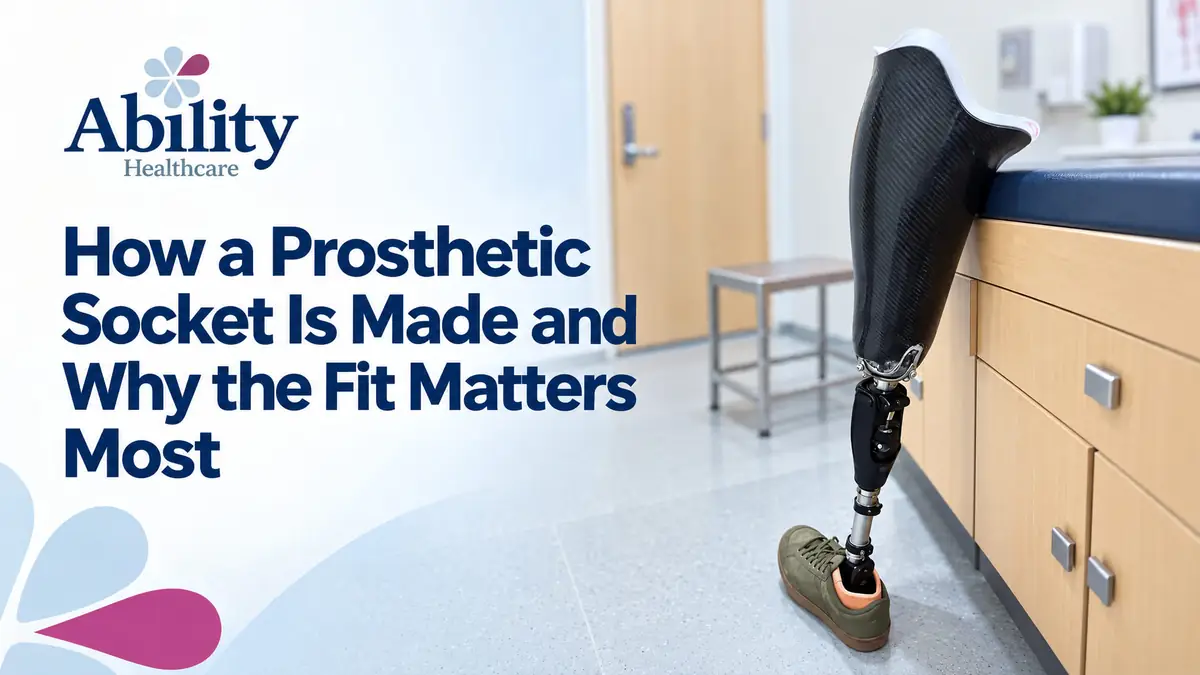
A prosthetic socket is the custom-made part of an artificial limb that holds your residual limb. It is made from an exact model of your limb, tested in a clear trial socket, and then finished in a strong material. The fit of the socket matters more than any other part, because it decides whether the limb feels comfortable, stays on safely and protects your skin.
People often focus on the knee, the foot or the price. Yet most of the day-to-day comfort of an artificial leg comes down to this one hidden part. This guide explains what the socket does, how it is made, and how to tell when the fit is no longer right.
What Is a Prosthetic Socket?
In simple terms, the prosthetic socket is the “cup” your residual limb sits in. Every other part of the prosthesis, such as the pylon, knee and foot, is attached to it. Physiopedia’s guide to lower limb sockets and suspension describes it as “the primary and critical interface between the residual limb and the rest of the prosthesis.”
The StatPearls review on prosthetics, published by the US National Library of Medicine, notes that the socket “protects the residual limb” and “allows for weight-bearing and load distribution.” In other words, it carries your body weight with every step.
Why Prosthetic Socket Fit Matters Most
A 2020 study in Archives of Rehabilitation Research and Clinical Translation asked amputees and clinicians what most affects rehabilitation. The answer was clear: “Issues related to socket fit were identified as the biggest factor affecting rehabilitation.” The authors of the study on the perceived effect of socket fit concluded that socket fit “has a large effect on and is a large source of frustration to amputees and their clinical teams.”
Good prosthetic socket fit means your weight goes through the areas of the limb that tolerate pressure, and away from sensitive bone ends and scars. Poor fit can cause pain, rubbing, sores and an unsteady walk. StatPearls also notes that an inappropriate fit “may also lead to excessive sweating and cyst formation.”
How a Prosthetic Socket Is Made, Step by Step
The prosthetic limb manufacturing process always starts with the socket, because everything else is aligned to it. Before your first visit, bring your surgeon’s discharge summary and any old prosthesis or socket you have used. Prosthetic socket fabrication usually follows these steps:
- Assessment of your residual limb, skin and walking goals
- Taking an impression with a plaster cast or a 3D scan
- Making and shaping a positive model of your limb
- Making and testing a clear check socket
- Making the final socket and building the limb onto it
- Alignment, walking training and follow-up
Assessment and Measurement
Your prosthetist examines the length and shape of the limb, checks the skin and scar, feels for tender spots, and asks about your daily activities. These details guide every later decision.
Plaster Cast for Prosthesis or 3D Scanning for Prosthetics
Next comes an impression of the limb. Physiopedia explains that this “is an impression of the limb’s outer surface, usually captured in plaster bandage or by digital scan.” A plaster cast for prosthesis work is the traditional method and still widely used. 3D scanning for prosthetics captures the shape digitally, which can make the model easier to store and adjust. At Ability Healthcare we already use 3D scanning in our foot pressure mapping service, and your prosthetist will advise which method suits your limb.
Shaping the Positive Model
The impression is turned into a positive model, a replica of your limb. The prosthetist then carefully adjusts it, building in relief over sensitive areas and extra contact where the limb can take load. This is where much of the skill lies.
Check Socket Prosthetics
Before the final socket is made, a trial socket is moulded over the model. According to Physiopedia, a check socket is “typically a clear plastic socket that lets the clinician see the fit against the limb.” You stand and walk in it while the prosthetist looks for pressure marks and gaps, then corrects them. Check socket prosthetics work helps prevent fit problems later.
Thermoplastic Socket and Carbon Fibre Prosthetic Socket
Once the fit is right, the final socket is made. A thermoplastic socket is moulded from heated plastic and can sometimes be reshaped slightly later. A laminated or carbon fibre prosthetic socket is built in layers with resin, giving a strong, light result. The choice depends on your weight, activity level and budget.
How long does it take to make a prosthetic socket? It usually needs several visits over a few weeks, because the check socket stage should not be rushed.
Types of Prosthetic Sockets
There are several types of prosthetic sockets, and the right one depends on your amputation level.
PTB Socket and TSB Socket
For below knee amputation, the two main designs are the PTB socket and the TSB socket. StatPearls states that “The most commonly used socket today is a patellar tendon-bearing (PTB) prosthesis.” In a PTB socket, weight is carried mainly through the tendon just below the kneecap. In a TSB (total surface bearing) socket, Physiopedia explains, “The weight bearing takes place all over the residual limb surface.” Our guide to above knee vs below knee prosthesis explains how amputation level affects the whole leg.
Quadrilateral Socket and Ischial Containment Socket
For above knee amputation, the older quadrilateral socket takes much of the weight on the sitting bone, through a shelf at the back. The ischial containment socket wraps more closely around the upper thigh and pelvis. Physiopedia notes that in this design “Weight bearing is distributed across the residual limb surface rather than concentrated at the ischial tuberosity,” and that it has progressively replaced the quadrilateral design.
Prosthetic Liners and Prosthetic Suspension Systems
A prosthetic liner is a soft sleeve that rolls onto the limb before it goes into the socket. Prosthetic suspension systems are the methods that hold the socket on. The two work together.
Silicone Liner Prosthesis and Gel Liner Prosthesis
A silicone liner prosthesis setup cushions the skin and helps the socket grip. A gel liner prosthesis works in a similar way with a softer feel. Liners need daily washing and eventually replacing. StatPearls notes that liners, socks and suspension parts are the most common cause of contact dermatitis, so tell your prosthetist about any rash.
Pin Lock Prosthesis
In a pin lock prosthesis, Physiopedia describes “A silicone or gel liner with a distal pin” that “engages a locking mechanism in the socket base.” You hear a click as it locks, and press a release button to take it off. It is simple to use.
Suction Socket Prosthesis
A suction socket prosthesis holds on by air pressure. StatPearls explains that it uses a liner “with a one-way expulsion valve,” often with a sealing sleeve. It gives a close, secure feel but needs a steady limb volume to seal well.
Vacuum Assisted Suspension
Vacuum assisted suspension goes a step further. According to Physiopedia, “A mechanism/pump actively removes air between the liner and socket wall, creating uniform negative pressure.” It is often chosen by more active users and usually costs more.
How Should a Prosthetic Socket Fit?
How should a prosthetic socket fit? It should feel snug and supportive, like a firm handshake, without sharp pressure points. You should be able to stand and walk without the limb slipping or pistoning up and down. After taking it off, any redness should fade fairly quickly.
A socket can also be too tight. StatPearls warns that a socket that is too snug can block blood flow out of the limb, a problem known as choke syndrome. Swelling or discolouration at the end of the limb needs prompt attention.
Prosthetic Socket Problems and Warning Signs
Most prosthetic socket problems are fixable if they are caught early.
Prosthetic Socket Pain
Prosthetic socket pain usually points to a pressure spot, a change in limb shape, or an alignment issue. Do not “push through” sharp or increasing pain.
Stump Shrinkage and a Loose Prosthetic Socket
Stump shrinkage is normal in the first months after surgery. Johns Hopkins Medicine notes that changes in limb shape usually occur in the first year after an amputation before the tissue settles. As the limb shrinks, the result is a loose prosthetic socket, which can cause rubbing and instability.
Using Prosthetic Socks
Prosthetic socks are the first fix for a slightly loose fit. They come in different thicknesses and are added or removed through the day as limb volume changes. If you need many layers, the socket probably needs changing.
Pressure Sores From Prosthesis and Stump Care
Pressure sores from prosthesis use start as red areas that do not fade. Good stump care, meaning daily washing, drying and checking of the limb, helps you catch them early. Stop wearing the limb and contact your prosthetist if the skin breaks.
How Often Should a Prosthetic Socket Be Replaced?
There is no fixed timetable for how often a prosthetic socket should be replaced. A new socket is often needed in the first year as the limb settles, and later whenever your weight, limb shape or activity changes, or the socket wears out. Regular reviews help decide the right time.
Prosthetic Socket Price and Replacement Cost in India
The prosthetic socket price depends on the design, material, liner and suspension. Prosthetic socket replacement cost in India is usually lower than a whole new limb, because the knee and foot can often be reused. For the full picture, see our guide to artificial leg price in India. Ability Healthcare gives a written quotation after assessment.
Nakli Pair Ka Socket (नकली पैर का सॉकेट कैसे बनता है)
प्रोस्थेटिक सॉकेट क्या है? Yeh nakli pair ka woh hissa hai jismein aapka bacha hua pair rehta hai. Nakli pair ka socket aapke pair ke naap ya scan se banta hai, phir ek trial socket se fitting jaanchi jaati hai, aur uske baad final socket banta hai.
Agar नकली पैर के सॉकेट में दर्द ho, chhale padein ya socket dheela lage, toh ise nazarandaaz na karein. Apne prosthetist se jaanch karwayein, kyunki zyadatar samasyaon ka hal adjustment se ho jaata hai.
Prosthetic Socket Fitting in Lucknow
For prosthetic socket fitting in Lucknow, Ability Healthcare offers assessment, casting, check socket trials and follow-up adjustments at our artificial limb centre in Lucknow. We also see patients at our clinics in Azamgarh, Bareilly and Gorakhpur.
Whether you need a first socket or a replacement, start with an assessment. You can read more about our artificial leg services or visit our page on the artificial leg in Lucknow.
Frequently Asked Questions
Why does my prosthetic socket hurt?
Usually because of a pressure point, a change in limb volume, or alignment. A loose socket can rub, and a tight one can press. Your prosthetist can find the cause and adjust it.
Can a prosthetic socket be adjusted?
Yes, often. Thermoplastic sockets can sometimes be reshaped, pads can be added, and sock layers changed. If the limb has changed a lot, a new socket is the better answer.
How long does it take to make a prosthetic socket?
A prosthetic socket usually takes several visits over a few weeks to make, including the check socket stage.
Is a carbon fibre socket better?
A carbon fibre socket is not always better. Carbon fibre is strong and light, but the best material is the one that suits your weight, activity and budget.
Does the same socket work for an artificial hand?
The principles are the same. Upper limb sockets are also custom-made, and our artificial hand services explain those options.
The Bottom Line
The socket is the part of a prosthesis you feel every minute you wear it. A careful impression, a properly tested check socket, the right liner and suspension, and regular reviews as your limb changes all matter more than any single component.
Disclaimer: This article is for general information only and is not a substitute for medical advice. Please consult a qualified prosthetist about your own situation.