If you or someone in your family is facing a leg amputation, two questions usually come up first. Will I walk again, and how much will a new leg cost? The answer to both depends a great deal on one thing: whether the amputation is above the knee or below it.
In this guide, we compare the above knee vs below knee prosthesis side by side. We cover what each one is, the typical cost in India, how long fitting takes, and what recovery looks like. We have kept the language simple, because these decisions are hard enough already.
Quick Answer: Above Knee vs Below Knee Prosthesis
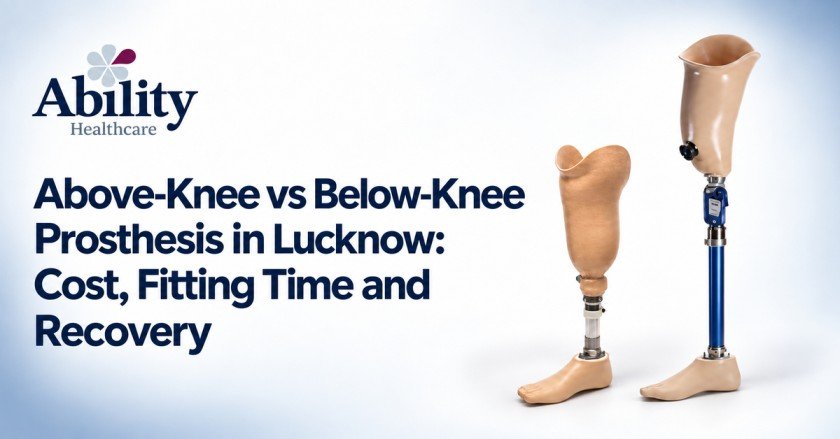
A below knee prosthesis replaces the lower leg and foot. Your own knee still does the bending, so walking usually feels more natural and takes less effort. An above knee prosthesis has to replace the knee as well, so it needs a mechanical, hydraulic or computer-controlled knee joint. That makes it more complex, often more expensive, and usually slower to learn.
| Factor | Below knee (transtibial) | Above knee (transfemoral) |
| Natural knee kept | Yes | No, an artificial knee joint is needed |
| Energy needed to walk | Lower | Higher |
| Typical learning period | Shorter | Longer |
| Indicative cost range | Lower overall | Higher overall |
| Main cost driver | Socket, liner and foot | Knee joint |
Below Knee vs Above Knee Amputation: What Is the Difference?
The level of amputation is decided by your surgeon, based on blood supply, infection, injury and healing. It is a medical decision first. A prosthesis is then designed around the limb that remains.
What Is a Transtibial Prosthesis?
A transtibial prosthesis is the clinical name for a below knee prosthesis. It fits a limb where the amputation passed through the shin bone (tibia). It has three main parts: a socket that holds the residual limb, a pylon (a supporting tube) and a prosthetic foot.
What Is a Transfemoral Prosthesis?
A transfemoral prosthesis is the clinical name for an above knee prosthesis. It fits a limb where the amputation passed through the thigh bone (femur). Along with the socket, pylon and foot, it has a prosthetic knee joint, which is the part that most affects how you walk, how safe you feel and what the leg costs.
Which Is Better, Above Knee or Below Knee Amputation?
When there is a medical choice, surgeons generally try to save the knee if it is safe to do so. The knee joint makes a big difference to daily life. Research comparing amputation levels shows that walking with a transfemoral prosthesis generally takes more energy than walking with a transtibial one (systematic review on PubMed).
That said, “better” is not the same for every person. A healthy, well-healed above knee limb can be more useful than a below knee limb with poor skin or circulation. Your surgeon and prosthetist will look at your whole situation.
Is It Easier to Walk with a Below Knee Prosthesis?
For most people, yes. With a below knee prosthesis, your own knee bends and straightens as normal, so balance, stairs and sitting down feel more familiar. People with an above knee prosthesis can walk well too, but they need to learn to control the artificial knee, and this usually takes more practice.
Components That Shape the Price
Two legs that look similar can be very different in price. The parts inside make the difference.
Below Knee Prosthesis Components
• PTB prosthesis: PTB stands for patellar tendon bearing. This socket design takes much of your weight through the tendon just below the kneecap. It is a well-established and cost-effective option.
• Silicone liner for below knee prosthesis: A soft liner sits between your skin and the socket. It improves comfort and grip, and can reduce rubbing. Liners wear out and need replacing over time.
• Prosthetic foot: Options range from a basic SACH (solid ankle cushion heel) foot to energy-storing designs. Carbon fibre foot price in India depends on the brand and activity level it is built for, and it can add significantly to the total.
Above Knee Prosthesis Components
• Prosthetic knee joint: Prosthetic knee joint price in India varies more than any other part. A basic single-axis knee is the most affordable. Polycentric and hydraulic knees offer smoother movement at a higher price.
• Microprocessor knee: A microprocessor knee uses sensors to adjust resistance as you walk, which can help with stability on slopes and stairs. Microprocessor knee price in India is at the top end of the range. You can read more on our microprocessor knee page.
What About a Modular Prosthesis?
A modular prosthesis is built from separate parts that connect together. The advantage is flexibility: a foot or knee can be upgraded or replaced without rebuilding the whole leg. Modular prosthesis price depends entirely on which parts you choose, which is why an assessment matters more than a price list.
How Much Does a Prosthetic Leg Cost in India?
This is the question we hear most often. Artificial leg price in India can range from a few thousand rupees for very basic limbs to many lakhs for advanced technology. The table below gives indicative ranges seen across the Indian market. These are not fixed prices. Your final cost depends on your limb, your activity level and the parts you choose.
| Type of prosthesis | Indicative price range in India |
| Basic below knee (conventional or Jaipur Foot style) | Around ₹10,000 to ₹40,000 |
| Modular below knee with PTB or total surface bearing socket | Around ₹40,000 to ₹1,50,000 |
| Advanced below knee with silicone liner and carbon fibre foot | Around ₹1,50,000 to ₹4,00,000 or more |
| Basic above knee with single-axis knee | Around ₹50,000 to ₹1,50,000 |
| Above knee with polycentric or hydraulic knee | Around ₹1,50,000 to ₹5,00,000 |
| Above knee with microprocessor knee | Often ₹8,00,000 and above |
Prices are indicative only and may change. Ability Healthcare shares a written estimate after a personal assessment.
Below Knee Prosthesis Price in India
The artificial leg below knee price is usually lower, because there is no knee joint to pay for. The biggest cost choices are the socket design, whether you use a silicone liner, and the type of foot.
Above Knee Prosthesis Price in India
The artificial leg above knee price is usually higher, mainly because of the knee joint. A person who walks mostly at home may do very well with a simpler knee. A person who works outdoors or travels a lot may benefit from a more advanced one.
What About Jaipur Foot Price?
The Jaipur Foot is a rubber-based foot developed in India, known for being low-cost and suited to walking barefoot and sitting cross-legged. The charity behind it, Bhagwan Mahaveer Viklang Sahayata Samiti (BMVSS), provides limbs free of charge at its centres. Commercially, Jaipur Foot style limbs are among the most affordable options.
Prosthetic Leg Cost in India: What Else Adds Up?
When comparing prosthetic leg cost in India, also plan for socket changes in the first year (your limb shrinks as it heals), liners and socks, servicing, and physiotherapy sessions. Asking for a full estimate, not just the price of the leg, avoids surprises later.
Free Artificial Limb Scheme and Government Support
Cost should not stop anyone from walking again. Several government routes can help people in Lucknow and across Uttar Pradesh.
ADIP Scheme for Artificial Limbs
Under the ADIP scheme of the Department of Empowerment of Persons with Disabilities, eligible Indian citizens with at least 40% disability can get aids and appliances, including prostheses. According to the official ADIP guidelines, people with a monthly income up to ₹22,500 can receive full assistance within the scheme’s cost limits, and those earning ₹22,501 to ₹30,000 can receive 50%. You need a UDID card or a disability certificate, which you can apply for through the official Swavlamban Card portal.
ALIMCO Artificial Leg Price and Support
Artificial Limbs Manufacturing Corporation of India (ALIMCO) is a Government of India enterprise based in Kanpur, Uttar Pradesh, and is one of the implementing agencies for ADIP. ALIMCO artificial leg price and availability are set by ALIMCO itself, so it is best to check with them directly or at their assessment camps.
Scheme rules can change, so always check the latest details on the official websites.
Prosthetic Leg Fitting After Amputation: The Timeline
When Can a Prosthesis Be Fitted After Amputation?
A prosthesis can only be fitted once the wound has healed and swelling has settled. For many people this is around six to twelve weeks after surgery, but it can take longer if you have diabetes, poor circulation or wound problems. Your surgeon and prosthetist will decide when your limb is ready.
How Long Does It Take to Get a Prosthetic Leg?
Once your limb is ready, making the leg itself is usually a matter of weeks, not months. At Ability Healthcare, the process generally follows these steps:
1. Assessment of your limb, health and daily goals
2. Measurement, casting or 3D scanning of the residual limb
3. A trial (check) socket to test the fit
4. Final fitting and alignment
5. Walking training and follow-up visits
The exact time depends on the parts chosen and how quickly the fit is right.
Recovery Time: Below Knee vs Above Knee Amputation
Below Knee Amputation Recovery Time
Many people with a below knee amputation take their first steps on a prosthesis within a few months of surgery, and then keep improving over the following months. Keeping your own knee usually makes this recovery quicker.
Above Knee Amputation Recovery Time
Above knee amputation recovery time is usually longer. Learning to trust and control an artificial knee takes time, practice and patience. Our guide on how long after amputation you can walk again explains the stages in more detail.
Stump Care After Amputation
Good stump care after amputation protects your skin and helps your prosthesis fit well. Wash and dry the residual limb daily, check for redness or sores, and use a compression sock or shrinker as advised to control swelling. The leg amputation recovery guide from Guy’s and St Thomas’ NHS Foundation Trust also explains how compression and early exercises support healing. Contact your clinician if you notice a wound, blister or pain that does not settle.
Prosthetic Gait Training
Prosthetic gait training teaches you to walk safely and evenly with your new leg. A physiotherapist and prosthetist work with you on balance, weight shifting, turning, stairs and slopes. This step matters as much as the leg itself. You can read about daily life after limb loss in our article on life after leg amputation.
How Long Does a Prosthetic Leg Last?
With good care, many prosthetic legs last around three to five years before major parts need replacing. Sockets often need changing sooner, especially in the first year, because the residual limb changes shape. Liners, feet and knee parts wear at different rates. Regular check-ups help catch problems early.
Nakli Pair Ki Kimat: कृत्रिम पैर की कीमत Hindi Mein
Bahut se log hamse poochhte hain, “nakli pair ki kimat kitni hai?” ya “nakli pair lagwane ka kharcha kitna aata hai?” Iska seedha jawab hai: kritrim pair ki keemat is baat par nirbhar karti hai ki amputation ghutne ke upar hua hai ya neeche.
• Ghutne ke neeche nakli pair: Ghutne ke neeche wala nakli pair aam taur par kam kharch mein ban jaata hai, kyunki isme ghutne ka joint nahi lagta.
• घुटने के ऊपर नकली पैर: Ismein artificial knee joint lagta hai, isliye iski keemat aur training ka samay dono zyada ho sakte hain.
• Nakli pair: Sahi fitting, achha socket aur physiotherapy, teeno milkar hi aaram se chalna sambhav banate hain.
Sahi keemat jaanne ke liye apne nazdeeki clinic mein jaanch karwayein.
Artificial Leg in Lucknow: Your Local Artificial Limb Centre
If you are looking for an artificial limb centre in Lucknow, Ability Healthcare has been supporting patients across the city and region for more than ten years. As an artificial limb centre in Uttar Pradesh, we also have clinics in Azamgarh, Bareilly and Gorakhpur.
When you choose a prosthetic leg in Lucknow with us, you can expect:
• A detailed assessment before any price is discussed
• Below knee and above knee prostheses, from basic to advanced
• 3D scanning and custom socket design
• Walking training and follow-up care
Learn more about our artificial leg services or visit our Lucknow clinic at Plot No. 9A, Kaushalpuri, Gomti Nagar Extension, Lucknow 226010.
Frequently Asked Questions
Is a below knee prosthesis cheaper than an above knee prosthesis?
Usually, yes. A below knee prosthesis does not need a knee joint, which is often the most expensive part of an above knee prosthesis.
How soon can I get a prosthetic leg after surgery?
Most people are fitted once the wound has healed and swelling has reduced. This is often around six to twelve weeks after surgery, though it varies from person to person.
Can I get a free artificial leg in Uttar Pradesh?
You may be eligible for help under the ADIP scheme if you meet the disability and income criteria. Check the official DEPwD website for the latest rules.
Can elderly people use an above knee prosthesis?
Many older adults do, but it depends on heart and lung health, balance and strength. A careful assessment helps decide whether it is safe and useful.
How often does a prosthetic leg need servicing?
A check-up every six to twelve months is a sensible routine, with extra visits if the fit changes or something feels wrong.
The Bottom Line
A below knee prosthesis is usually simpler, more affordable and quicker to learn. An above knee prosthesis needs an artificial knee, so it often costs more and takes longer to master. With the right fit, good training and steady follow-up, people at both levels can return to a full and active life.
If you would like a personal estimate, our team in Lucknow is here to help.
Disclaimer: This article is for general information only and is not a substitute for medical advice. Prices are indicative and may vary. Please consult a qualified doctor or prosthetist for advice about your situation.