In the first few weeks after surgery, almost every patient asks the same question, usually quietly, usually to a nurse rather than a doctor. When will I walk again?
The honest answer is that most people with a below-knee amputation take their first steps on a prosthesis somewhere between eight and twelve weeks after surgery, and walk independently indoors for four to six months. Above-knee amputation usually takes longer. Diabetic amputation often takes longer still.
But a timeline made of averages is not much use when you are the person waiting. So this guide walks through what actually happens week by week, what has to be true before a prosthesis can be fitted, and which things speed recovery up or slow it down. It includes the difficult parts too, because being told the truth is more useful than being told what you hope to hear.
The Short Answer
| Amputation level | First prosthetic fitting | Walking indoors with support | Independent walking |
| Toe or partial foot | 2 to 6 weeks | 4 to 8 weeks | 2 to 4 months |
| Below knee (BKA) | 6 to 12 weeks | 3 to 4 months | 4 to 6 months |
| Above knee (AKA) | 10 to 16 weeks | 4 to 6 months | 6 to 12 months |
| Diabetic amputation | Add 4 to 10 weeks | Varies | Varies |
These are typical ranges, not promises. Your own amputation recovery timeline depends on how well the wound heals, your age, your general health, your muscle strength before surgery, and how consistently you do your rehabilitation.
What Decides How Quickly You Walk Again
Six factors shape almost every recovery.
Wound healing. Nothing starts until the surgical wound has closed properly. This is the single most common reason timelines stretch.
Amputation level. The more joints the prosthesis has to replace, the more energy walking costs and the longer training takes. A below-knee amputee uses roughly 20 to 25 percent more energy to walk than someone with two legs. For above-knee amputees, it is closer to 60 to 70 percent.
Cause of amputation. Trauma patients are often younger with healthy circulation and recover faster. Vascular and diabetic amputations involve compromised blood supply, so healing is slower.
Age and fitness. Balance, core strength and cardiovascular fitness matter more than most people expect. Someone who was walking well before surgery usually walks again sooner.
Other health conditions. Heart disease, kidney disease, poor vision and neuropathy in the remaining leg all affect the pace.
Rehabilitation consistency. This is the one you control. Patients who do their exercises daily walk sooner. It is that simple, and it is the single biggest variable in your own hands. Johns Hopkins Medicine sets out the structured rehabilitation approach that underpins this.
Amputation Recovery Stages: A Week by Week Timeline
Days 1 to 7: Immediate Post-Operative
Pain control, wound monitoring and bed mobility. Physiotherapy starts within a day or two, focusing on breathing, positioning and gentle movement of the remaining joints. You will be taught how to lie flat on your stomach for short periods to prevent hip contractures.
You will also learn to move safely between bed and chair. This is the first step toward walking, even though it looks nothing like walking.
Weeks 2 to 4: Wound Healing and Early Mobility
Amputation wound healing time is typically three to six weeks for a straightforward closure. Stitches or staples usually come out between days 14 and 21.
During this stage you should be:
- Standing at parallel bars or with a walker on your remaining leg
- Practising transfers independently
- Doing hip and knee range of motion exercises
- Beginning stump desensitisation
Wheelchair or walker use is normal here and is not a sign of failure. It preserves the remaining leg while the residual limb heals.
Weeks 4 to 8: Stump Shaping
Once the wound is closed, the focus shifts to shaping the residual limb into a firm, tapered, cone-like shape that a socket can hold. This is the stage most people know nothing about, and it decides how well your prosthesis will eventually fit.
Weeks 6 to 12: Casting and First Fitting
When the limb is ready, your prosthetist takes a cast or scan, builds a test socket, and you attend a trial fitting. Adjustments follow.
Weeks 8 to 16: Gait Training
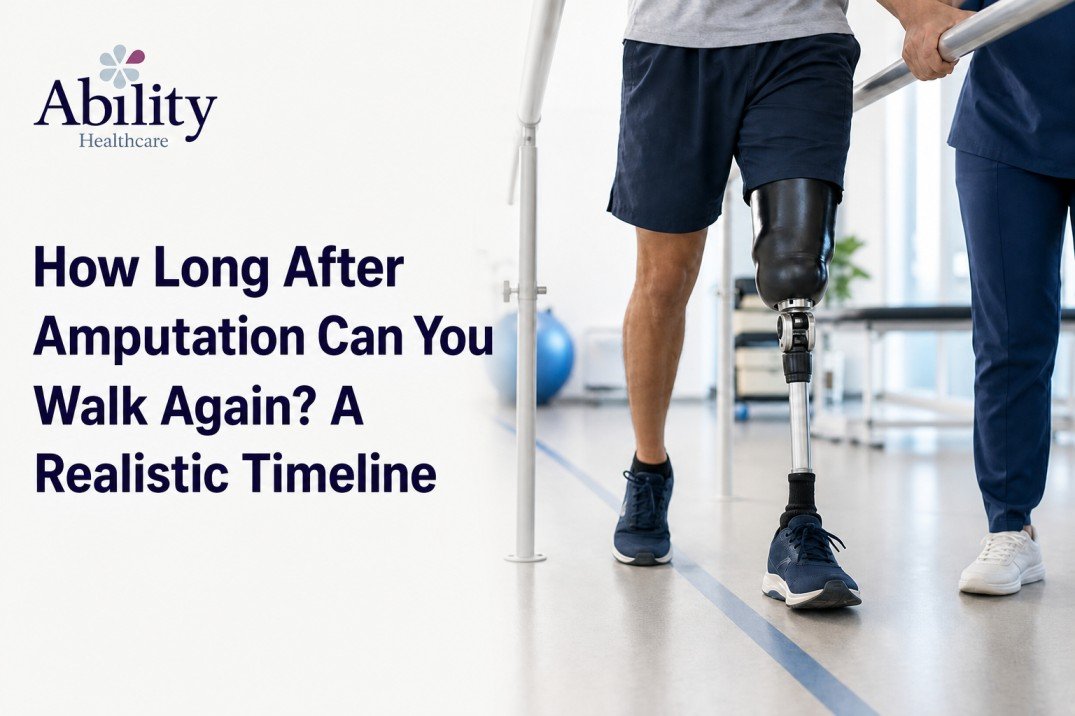
Your first steps after amputation happen here, usually between parallel bars with a physiotherapist on either side. Sessions are short at first and build gradually.
Months 4 to 12: Independence and Refinement
Walking outdoors, on slopes, on uneven ground and on stairs. Socket adjustments as your limb volume settles. Return to work, driving and social life.
Walking After Below Knee Amputation
Below knee amputation recovery time is the shortest of the major levels, because your own knee is intact. That knee does the work of controlling the limb, which makes both balance and energy cost far more manageable.
A typical BKA recovery walking timeline:
- Weeks 3 to 6: Wound closed, compression begun
- Weeks 6 to 10: Casting and first prosthetic fitting
- Weeks 8 to 14: Gait training, walking indoors with a walker or sticks
- Months 4 to 6: Independent walking indoors and short distances outdoors
- Months 6 to 12: Confident walking on uneven ground, stairs, longer distances
Many below knee amputees return to full daily activity, including work and driving, within six months.
Walking After Above Knee Amputation
Above knee amputation recovery time is longer, and it helps to understand why rather than simply being told to be patient.
Without your own knee, the prosthesis has to provide stability when you stand and control when the leg swings forward. Learning to trust a mechanical knee takes practice, and it requires real hip and core strength to drive the limb.
A typical AKA recovery walking timeline:
- Weeks 4 to 8: Wound healing and compression
- Weeks 10 to 16: Casting and first fitting
- Months 4 to 6: Walking indoors with support
- Months 6 to 12: Independent walking, outdoor confidence, stairs
Some older above knee amputees with vascular disease do not achieve independent outdoor walking, and use a wheelchair for distance while using the prosthesis for transfers and short indoor walking. That is a legitimate and useful outcome, not a failure, and it is better to plan for it honestly than to be surprised by it.
Diabetic Foot Amputation Recovery
Diabetes changes the picture in three ways. Blood supply to the tissues is reduced, so healing is slower. Neuropathy means you may not feel pressure damage developing. And the remaining foot is also at risk, which makes protecting it a priority throughout.
Practical expectations for diabetic foot amputation recovery:
- Wound healing frequently takes six to twelve weeks rather than three to six
- Prosthetic fitting is often delayed to weeks twelve to twenty
- Blood sugar control directly affects how fast tissue heals
- Daily inspection of the remaining foot is non negotiable
- Specialist footwear or an insole for the sound side is usually needed
Recovery after toe amputation and walking is generally much quicker, often two to six weeks before comfortable walking in a modified shoe. But the same warning applies: a toe amputation in a diabetic patient is a signal to protect the rest of the foot seriously.
Stump Care After Amputation: The Phase That Decides Everything
If there is one section of this article worth reading twice, it is this one. Stump care after amputation during weeks two to ten determines how well your socket fits, and socket fit determines whether you actually wear the prosthesis.
How to Reduce Swelling After Amputation
Swelling in the stump after amputation is normal in the early weeks and needs active management:
- Elastic bandaging in a figure-of-eight pattern, firmer at the end of the limb and lighter toward the top. Never wrap in circular rings, which acts like a tourniquet.
- Elevation of the limb when resting, without propping the knee bent on a pillow, since that encourages contractures.
- Gentle exercise to encourage circulation.
Shrinker Sock for Amputees
Once the wound has closed, a shrinker sock for amputees replaces bandaging in most cases. It is an elasticated sleeve that applies graded compression, and it is far more consistent than hand bandaging.
Typical use is 23 hours a day, removed only for washing and skin checks. Most patients need two so one can be washed while the other is worn. Replace it when it loses elasticity, usually every three to four months.
Stump Shrinkage Timeline
The stump shrinkage timeline follows a fairly predictable pattern. Most volume loss happens in the first three months, with continued gradual shrinkage for up to twelve to eighteen months. This is why your first socket will need adjusting and why a replacement socket is normal within the first year. It is not a fault in the fitting.
When Is the Stump Ready for Prosthesis?
Your prosthetist is looking for:
- A fully closed, healed wound with no open areas
- Swelling settled and limb volume reasonably stable
- A firm, tapered, cylindrical or conical shape
- Skin that tolerates touch and pressure without pain
- No fixed contracture at the hip or knee
- Adequate strength to bear weight
Rushing this stage produces a socket that fits for three weeks and then does not, which costs more time than waiting did.
Pre Prosthetic Exercises: What to Do Before Fitting
The exercises before prosthetic fitting are what make gait training go quickly instead of slowly. Start them as soon as your surgical team permits.
For all levels:
- Lying on your stomach for 20 to 30 minutes twice daily to prevent hip contractures
- Core and trunk strengthening
- Upper body strengthening for walker and crutch use
- Single leg balance work while holding a stable surface
- Cardiovascular work such as arm cycling
Below knee specifically: knee straightening strength and full knee extension range.
Above knee specifically: hip extension and hip abduction strength, which drive the prosthetic knee.
Stump desensitisation: rubbing the limb with different textures several times a day so it tolerates socket contact comfortably.
The VA Veterans Health Library guidance on lower limb amputation rehabilitation covers this preparatory phase in detail.
First Prosthetic Fitting: What to Expect
Your first fitting is an assessment session, not a delivery. Expect measurement, casting or scanning, and a discussion about your activity goals and which components suit them.
A test socket is made first. You will stand in it, walk a few steps, and report where it presses. Adjustments are made, sometimes over several visits, before the definitive socket is built. If a clinic offers to skip the test socket, that is a saving in the wrong place.
Expect the limb to feel heavy, strange and slightly unbalanced at first. Every patient says this. It passes.
Learning to Walk with a Prosthetic Leg: Gait Training
Gait training after amputation is a structured process, not a matter of standing up and trying.
Stage 1: Parallel bars. Weight shifting side to side, then forward and back, then stepping. Parallel bars gait training gives you two secure handholds while your brain relearns balance with a limb that has no sensation.
Stage 2: Walker or crutches. Moving out of the bars onto a walking aid, working on step length symmetry.
Stage 3: Sticks and then independence. Reducing support as balance improves.
Stage 4: Real world. Turning, uneven ground, kerbs, ramps, crowded spaces, and stairs.
How to Walk with a Prosthetic Leg on Stairs
The rule most physiotherapists teach is straightforward. Going up, lead with your sound leg. Coming down, lead with the prosthetic leg. Use the handrail throughout and take one step at a time until it becomes automatic. Below knee amputees often progress to normal step-over-step stairs. Above knee amputees may continue to lead with the prosthesis on descent unless they have a microprocessor knee.
How Many Hours a Day Should You Wear a Prosthetic Leg?
Start with one to two hours a day, split into short sessions. Remove the limb and inspect the skin after each one. Increase by an hour or so per day if the skin recovers well.
Any redness that does not fade within 20 minutes of removal means the socket needs adjusting. Most patients reach all-day wear within four to six weeks.
The Prosthetic Leg Adjustment Period
The first two to three months involve continual small changes. Expect socket adjustments, ply sock changes as your limb shrinks, alignment tweaks and muscle soreness in new places. This is normal and it settles.
Walking with Prosthetic Leg Problems
Why is my prosthetic leg painful? Pain is common early on, but it should always have an explanation, and you should never simply endure it.
| Problem | Likely cause | What to do |
| Pressure at the end of the limb | Socket too deep or limb has shrunk | Add socks, see your prosthetist |
| Rubbing at the socket rim | Alignment or trim line issue | Prosthetist adjustment |
| Limb rotating in socket | Limb volume loss, poor suspension | Sock ply change or new socket |
| Skin problems with a prosthetic leg | Sweat, friction, liner hygiene | Daily washing, liner care, review |
| Sharp shooting pain at one spot | Possible neuroma | Medical review |
| Back or hip pain | Leg length or alignment error | Prosthetist review |
The general principle: comfortable pressure is expected, sharp pain is not, and skin that breaks means stop wearing the limb and get it checked.
Complications That Delay Walking
Phantom Limb Pain
Most amputees experience phantom sensation, and a large proportion experience phantom limb pain, which is real pain felt in the part of the limb that is no longer there. It is a nervous system phenomenon, not imagination, and it should be treated as a genuine medical symptom.
Phantom limb pain treatment approaches include medication prescribed by your doctor, mirror therapy, desensitisation, graded motor imagery, TENS, and often simply using the prosthesis regularly, since restoring sensory input tends to reduce phantom pain over time. The NHS overview of amputation recovery explains phantom pain and its management clearly.
Neuroma
A neuroma after amputation is a sensitive nerve bundle at the cut end of a nerve, felt as sharp, electric or localised pain at a specific point. Socket modification often relieves the pressure. Persistent cases need medical or surgical review.
Infection
Watch for spreading redness, increasing warmth, swelling that worsens rather than improves, discharge or a bad smell, fever, or pain that increases after previously settling. Infection after amputation delays everything and needs prompt medical attention. Do not wait for a scheduled appointment.
Contractures
A hip or knee that will not straighten fully makes prosthetic fitting difficult or impossible. Prevention through positioning and daily stretching is far easier than treatment.
K Levels for Amputees Explained
Your prosthetist will assign you an activity level, and it determines which components suit you.
| Level | Description |
| K0 | Not able to walk or transfer safely with a prosthesis |
| K1 | Walking on level surfaces at a fixed slow pace, household use |
| K2 | Limited community walking, able to manage kerbs and uneven ground |
| K3 | Community walking at variable speed, most daily activities |
| K4 | High impact activity, sport, occupational demands |
Most adults in India fall into K1 to K3. Your level can improve as you get stronger, and it is reassessed rather than fixed forever. This matters financially too, since a K1 patient does not need a K3 component, and a good clinic will tell you so.
Life After Leg Amputation
Returning to work after amputation depends heavily on the job. Desk-based work is often possible within three to six months, sometimes sooner with a phased return. Physically demanding or standing work usually takes six to twelve months and may need workplace adjustments.
Driving after leg amputation in India is permitted, and vehicles can be adapted with hand controls or left-foot accelerators where needed. You will need medical clearance and should inform your insurer and licensing authority about the adaptation. Most people resume driving between three and six months.
Can amputees run? Yes, many can, but it needs a K3 or K4 activity level, good socket fit and usually a specialised running foot. Walking well comes first, and running typically comes at nine to eighteen months if it comes at all.
Emotional recovery after amputation deserves the same attention as physical recovery. Grief, frustration, low mood and anxiety about the future are ordinary responses to limb loss, not weakness. Progress is rarely a straight line, and setbacks are part of it. If low mood persists beyond a few weeks or is affecting your rehabilitation, speak to your doctor. Peer contact with other amputees helps more than almost anything else.
पैर कटने के बाद चलना: कितना समय लगता है?
Amputation ke baad kitne din mein chal sakte hain यह सवाल लगभग हर मरीज़ के मन में आता है। सामान्य तौर पर घुटने के नीचे कटाव वाले मरीज़ सर्जरी के लगभग 6 से 12 हफ़्ते बाद नकली पैर लगवाते हैं और 4 से 6 महीने में सहारे के बिना चलने लगते हैं। घुटने के ऊपर कटाव में यह समय ज़्यादा लगता है, आमतौर पर 6 से 12 महीने। डायबिटीज़ के मरीज़ों में घाव देर से भरता है, इसलिए समय और बढ़ सकता है।
पैर कटने के बाद देखभाल सबसे ज़रूरी हिस्सा है। घाव भरने के बाद स्टंप पर सही तरीके से पट्टी या श्रिंकर सॉक लगाना ज़रूरी है, ताकि सूजन कम हो और स्टंप का आकार सॉकेट के लिए तैयार हो सके। रोज़ाना पेट के बल लेटना, कूल्हे और घुटने की एक्सरसाइज़ करना और स्टंप को छूकर संवेदनशीलता कम करना, ये सब आगे चलकर बहुत मदद करते हैं।
नकली पैर लगाने के बाद चलना धीरे धीरे सीखा जाता है। शुरुआत पैरलल बार में की जाती है, फिर वॉकर, फिर छड़ी, और अंत में बिना सहारे। कृत्रिम पैर से चलना सीखना एक प्रक्रिया है जिसमें फिज़ियोथेरेपी और नियमित अभ्यास दोनों ज़रूरी हैं। शुरुआत में दिन में एक से दो घंटे ही पैर पहनें और हर बार त्वचा की जाँच करें।
Amputation Rehabilitation in Lucknow
Ability Healthcare provides artificial limb fitting and rehabilitation across Uttar Pradesh, with centres in Lucknow, Azamgarh, Bareilly and Gorakhpur.
The reason we mention rehabilitation and not just fitting is that the two cannot be separated. A well-made limb without gait training sits unused in a cupboard. Our prosthetic clinic in Lucknow provides:
- Pre-prosthetic assessment and guidance on stump preparation
- Advice on compression, shrinker socks and skin care while you wait
- Casting, test socket trial and definitive socket fabrication
- Component selection matched to your K level rather than to a price point
- Gait training from parallel bars through to outdoor and stair walking
- Physiotherapy for amputees coordinated with prosthetic adjustment
- Follow up reviews, socket adjustment and replacement as your limb changes
- Guidance on ADIP, ALIMCO and UDID applications where you may be eligible
If you are early in recovery and not yet ready for fitting, an assessment is still worth having. Getting compression and positioning right in weeks four to eight often saves a month later on.
Frequently Asked Questions
How long after amputation can you walk with a prosthetic leg?
Most below-knee amputees take their first prosthetic steps between eight and twelve weeks after surgery and walk independently indoors by four to six months. Above knee amputees typically take six to twelve months to reach independent walking.
Can you walk before getting a prosthesis?
Yes. Most patients walk with a walker or crutches on the remaining leg within days of surgery. This maintains fitness and balance and makes prosthetic training easier later.
Why is my prosthetic leg still painful after two months?
Persistent pain usually means the socket needs adjusting, often because your limb has shrunk. It can also indicate a neuroma or skin problem. It should be assessed rather than tolerated.
How long does stump swelling take to go down?
Most swelling settles over the first eight to twelve weeks with consistent compression, though limb volume continues to reduce gradually for up to eighteen months.
Will I walk normally again?
Many below knee amputees walk with a gait that is barely noticeable to others. Above knee walking usually remains visibly different, though it can be efficient and comfortable. Socket fit and training matter more to the outcome than the price of the components.
Does everyone learn to walk again after amputation?
Most people do. Some older patients with significant vascular disease or other health problems use the prosthesis for transfers and short distances while using a wheelchair for longer trips. That is still a meaningful gain in independence.
Where to Start
The most useful thing you can do while waiting for a prosthesis is to prepare for it. Keep the wound clean, use compression consistently, lie on your stomach every day, keep your hip and knee straight, and build your upper body and core strength. Patients who arrive at their first fitting already strong and well-shaped walk sooner.
If you or a family member is recovering from a leg amputation in Lucknow or elsewhere in Uttar Pradesh, come and talk to our team. Bring your discharge summary and, if you have one, a photograph of the residual limb.
This article is for general information and does not replace individual medical advice. Recovery timelines vary considerably between patients. Please follow the guidance of your surgical, rehabilitation and prosthetic team.