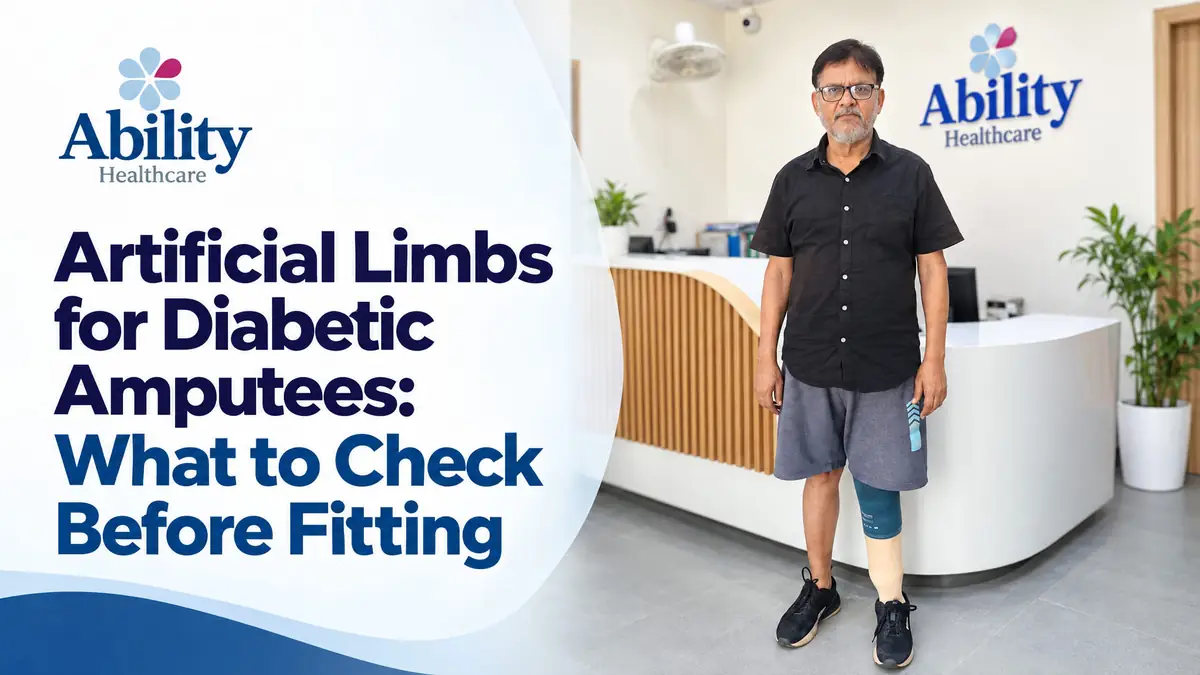
Artificial limbs for diabetic amputees work well for many people, but fitting needs extra checks first. The wound must be fully healed, sugar control should be stable, the skin and its sensation need checking, and the other foot must be protected. Your surgeon, diabetologist and prosthetist decide together when you are ready.
A diabetic amputation changes more than the leg. Wounds can heal more slowly, the skin may not feel rubbing or pressure, and the remaining foot now carries more load. This guide explains each check in plain language.
Can a Diabetic Patient Wear an Artificial Leg?
Yes, in many cases. An artificial leg for a diabetic patient works the same way as for anyone else. What differs is the preparation. Your care team will first confirm that the wound has healed and your sugar is being managed. They will also check that your skin, heart and balance can cope with the extra effort of walking on a prosthesis.
Some people are fitted with a full walking leg. Others, depending on their health, may use a prosthesis mainly for transfers and short distances. Both are worthwhile outcomes.
What to Check Before Prosthetic Fitting
Here is the short checklist. Each point is explained further down.
| Check | Why it matters |
|---|---|
| Wound fully healed | A prosthesis presses on the limb, so an open wound can break down |
| Swelling settled | The socket is shaped to your limb; swelling changes the fit |
| Sugar under control | Your doctor will review recent readings and HbA1c |
| Skin and sensation checked | Reduced feeling can hide rubbing and sores |
| Other foot examined | It now carries more load and needs protection |
| Heart, balance and strength | Walking with a prosthesis takes more effort |
| Support at home | Someone to help with daily skin checks early on |
Why Does Diabetes Lead to Amputation?
According to Mayo Clinic’s guide to amputation and diabetes, “Diabetes complications can include nerve damage and poor blood flow.” Nerve damage means a small cut or blister may go unnoticed. Poor blood flow means it heals slowly. The US National Institute of Diabetes and Digestive and Kidney Diseases explains in its page on diabetes and foot problems that “Gangrene and foot ulcers that do not get better with treatment can lead to an amputation.”
A diabetic foot amputation may remove a toe or part of the foot. Where the damage is more widespread, surgeons may need to amputate below or above the knee. That decision belongs to the surgeon, based on blood supply and infection. Our guide on above knee vs below knee prosthesis explains how the level affects the artificial leg.
Is My Stump Ready for Prosthesis?
Your stump is ready for a prosthesis when the wound has fully healed, swelling has settled and your doctors agree you are medically fit. Your surgeon and prosthetist make that call together, looking at the points below.
Stump Healing After Amputation
Stump healing after amputation must be complete before a prosthesis goes on. The socket puts steady pressure on the limb, and an unhealed wound can reopen under it. The US Centers for Disease Control and Prevention, in its guide to recovering from a diabetes-related amputation, notes that “It takes time to get fitted for a permanent prosthesis once the affected limb has completely healed”, and that most people start with a temporary prosthesis.
Wound Healing After Amputation in Diabetics
Wound healing after amputation in diabetics often takes longer, because reduced blood flow slows repair. Follow your surgeon’s dressing instructions exactly, keep appointments, and report any redness, discharge, smell or new pain straight away. Patience at this stage protects the limb for years to come.
Blood Sugar Level Before Prosthetic Fitting
Your doctor will want your blood sugar level before prosthetic fitting to be reasonably stable. There is no single number that applies to everyone, so we do not set one. Your diabetologist will decide what is safe for you.
HbA1c Before Artificial Limb Fitting
Doctors often look at HbA1c before artificial limb fitting too. As NIDDK explains on its page about the A1C test, the test “reflects your average blood glucose levels over the past 3 months.” It gives a better picture of control than a single reading.
Diabetic Neuropathy and Prosthesis Use
Diabetic neuropathy and prosthesis use need extra thought. If the skin on your residual limb has reduced feeling, you may not notice a pressure spot or rub until it becomes a sore. That is why visual checks matter more than “how it feels”.
Residual Limb Skin Care
Residual limb skin care is a daily habit. Stump care, meaning the routine cleaning, drying and checking of the remaining limb, protects the skin under the socket. A simple daily routine looks like this:
- Take off the prosthesis and liner.
- Wash the limb with mild soap and water, then dry it well, including skin folds.
- Look at the whole limb, using a mirror for the back.
- Watch for redness that does not fade within a short time, blisters, cuts or swelling.
- Call your prosthetist or doctor before wearing the leg again if you find a sore.
Our page on life after leg amputation covers stump care in more detail.
Choosing a Prosthesis for Diabetic Patients
A diabetic amputation prosthesis is built from the same parts as any other: a socket, a pylon, a foot and, above the knee, a knee joint. The difference is in how carefully the socket and liner protect the skin.
Gel Liner Prosthesis and Silicone Liner for Diabetic Amputees
A gel liner prosthesis uses a soft liner that rolls onto the limb before it goes into the socket. A silicone liner for a diabetic amputee can help spread pressure and reduce friction. Liners are not right for everyone, and they need daily cleaning, but they are often considered when skin is fragile.
Residual Limb Volume Fluctuation
Residual limb volume fluctuation is normal, especially early on. Johns Hopkins Medicine notes that changes in limb shape usually occur in the first year after an amputation before the tissue settles. Compression helps: the leg amputation recovery guide from Guy’s and St Thomas’ NHS Foundation Trust explains that the compression sock “helps to control any swelling.”
Prosthetic Socket Fitting Problems
Most prosthetic socket fitting problems come from these volume changes. A socket that fitted well in month one may feel loose by month four. Adding or removing prosthetic socks helps in the short term, and a socket replacement may be needed as the limb settles. Never ignore a socket that rubs or pinches.
Below Knee Amputation and Diabetes
For many people with a below knee amputation and diabetes, keeping the natural knee makes walking easier. A prosthetic leg for a diabetic amputee at this level usually has a total surface bearing or patellar tendon bearing socket, chosen to load the areas that tolerate pressure and protect the sensitive ones.
Protecting the Other Foot After Amputation
Protecting the other foot after amputation is as important as caring for the residual limb. That foot now takes more load, and the same diabetes that affected the first leg is still present. The CDC notes that people who have had a diabetes-related amputation face a higher risk of another one.
Good diabetic foot care follows a few simple rules. Mayo Clinic advises you to “check your feet once a day for blisters, cuts, cracks, sores, redness, tenderness or swelling” and to “have a foot exam at least once a year.” NIDDK also advises never walking barefoot or in just socks, even indoors.
For diabetic foot ulcer prevention, proper diabetic footwear matters. Shoes should fit well, protect the toes and spread pressure evenly. Our diabetic foot care services, customised insoles and foot pressure mapping can help find and protect high-pressure areas before a sore develops.
Recovery Time After Diabetic Amputation
Recovery time after diabetic amputation varies a great deal. It depends on healing, general health and how active you were before surgery. For a fuller timeline of the stages, read our guide How Long After Amputation Can You Walk Again?
Physiotherapy After Amputation
Physiotherapy after amputation starts early, often before the prosthesis is ready. The CDC notes that “Physical therapy helps you regain strength, balance, and range of motion.” Strong hips and a good core make walking with a prosthesis safer and less tiring.
How Long Does It Take to Get Used to a Prosthetic Leg?
There is no fixed answer to how long it takes to get used to a prosthetic leg. Some people feel confident within weeks, others take months. Johns Hopkins Medicine says that learning to get around with a prosthetic leg “can be a challenge.” Regular practice and follow-up visits make a real difference.
Artificial Leg Price for Diabetic Patients
The artificial leg price for a diabetic patient follows the same factors as for anyone else: amputation level, socket, liner, foot and knee. A protective liner or extra socket changes in the first year can add to the total. Our guide to the artificial leg price in India explains the ranges in detail.
ADIP Scheme Artificial Limb Support
Help with cost may be available. Under the ADIP scheme of the Department of Empowerment of Persons with Disabilities, Indian citizens with at least 40% disability can receive assistive devices, including artificial limbs. The official guidelines for the revised scheme in force from 1 April 2024 provide full assistance for monthly incomes up to ₹22,500 and 50% for ₹22,501 to ₹30,000, within the scheme’s cost limits. You need a disability certificate and a UDID card or UDID enrolment number, which you can apply for on the Swavlamban Card portal.
Sugar Ke Marij Ke Liye Nakli Pair (मधुमेह में कृत्रिम पैर)
Bahut se parivaron ke liye sugar se pair katna ek bada sadma hota hai. Lekin sugar ke marij ke liye nakli pair bilkul sambhav hai.
- Ghav poori tarah bhar jaaye: Nakli pair tabhi lagta hai jab ghav theek ho chuka ho.
- Sugar control mein ho: Apne doctor se HbA1c aur sugar ki jaanch karwate rahein.
- Doosre pair ka dhyan rakhein: Roz pair dekhein aur kabhi nange pair na chalein.
Nakali pair ya kritrim pair ke baare mein aur jaankari ke liye hamara Hindi lekh kritrim pair se foot pain kaise kam karein padhein.
Artificial Leg for Diabetic Patients in Lucknow
If you are looking for an artificial leg for a diabetic patient in Lucknow, start with an assessment rather than a product. At our artificial limb centre in Lucknow, we check the residual limb, skin and sensation, look at the other foot, and talk through your daily routine before recommending a design. We work alongside your surgeon and diabetologist, who remain in charge of your medical care.
Patients who need care for the remaining foot can also visit our diabetic foot clinic in Lucknow. For the prosthesis itself, see our artificial leg in Lucknow page or our main artificial leg services page.
Frequently Asked Questions
How often should a diabetic amputee check the stump?
Every day, and ideally each time the prosthesis comes off. Look for redness that does not fade, blisters, cuts or swelling. Use a mirror or ask a family member to help if you cannot see all of the limb.
Can a diabetic patient wear an artificial leg every day?
Many can, once the wound has healed and the fit is right. Wearing time is built up slowly, with skin checks after each session.
What is the most important check before prosthetic fitting?
The most important check is a fully healed wound. Without it, the socket can damage the limb, whatever the quality of the prosthesis.
Will I need a new socket soon after fitting?
Possibly, yes. The limb usually changes shape during the first year, so many people need a socket change in that period.
Does diabetes make an artificial limb more expensive?
Not by itself. The cost depends on the design, although protective liners and extra socket changes can add to it.
The Bottom Line
Artificial limbs for diabetic patients are very possible. Success depends on patience before fitting, a socket and liner chosen to protect the skin, daily checks of both the residual limb and the other foot, and close teamwork between your doctors and your prosthetist.
Disclaimer: This article is for general information only and is not a substitute for medical advice. Decisions about wound healing, blood sugar and fitness for prosthetic fitting must be made by your treating doctors. Scheme rules may change.