If climbing stairs has started to hurt, if your knee feels stiff for the first ten minutes after you get out of bed, or if your X-ray report mentions “joint space narrowing”, you are probably dealing with knee osteoarthritis. It is the most common joint condition in India, and it is also one of the most misunderstood. Many people assume the only real answer is knee replacement surgery. For a large number of patients, that simply is not true.
This guide explains what osteoarthritis is, how doctors grade it, what your non-surgical options are, and how the right knee brace can take pressure off the damaged part of your joint.
What Is Osteoarthritis?
Osteoarthritis is a degenerative joint disease in which the smooth cartilage that cushions the ends of your bones gradually wears down. As that cushion thins, bones begin to rub against each other, which causes pain, swelling, stiffness and reduced movement. The body also responds by forming small bony growths called osteophytes, or bone spurs.
According to the World Health Organization, osteoarthritis affects hundreds of millions of people worldwide, and the knee is the joint most commonly involved.
Difference Between Arthritis and Osteoarthritis
“Arthritis” is an umbrella term for more than a hundred conditions that cause joint inflammation. Osteoarthritis is one specific type, driven by mechanical wear and cartilage loss. The main difference between arthritis and osteoarthritis worth knowing is this: rheumatoid arthritis is an autoimmune disease where your immune system attacks the joint lining and usually affects joints on both sides symmetrically, while osteoarthritis is a wear related condition that often begins in one joint. The treatments are very different, which is why an accurate diagnosis matters.
What Is Osteoarthritis of the Knee?
Knee joint osteoarthritis, also called degenerative arthritis of the knee, happens when cartilage breaks down inside one or more of the knee’s three compartments: the medial (inner) side, the lateral (outer) side, and the patellofemoral compartment behind the kneecap.
In India, the medial compartment is affected most often. This is partly because many people have a slight bow legged (varus) alignment, which sends extra load through the inner side of the knee every time they take a step. Over years, that uneven loading wears the inner cartilage faster. Understanding which compartment is damaged is the key to choosing the right treatment, because it determines whether an offloading brace will help you.
ऑस्टियोआर्थराइटिस क्या है? (Osteoarthritis Kya Hai)
ऑस्टियोआर्थराइटिस को आम भाषा में घुटनों का घिसाव कहा जाता है। इसमें घुटने की हड्डियों के बीच की कार्टिलेज धीरे धीरे घिस जाती है, जिससे चलने, सीढ़ी चढ़ने और उठने बैठने में दर्द होता है। ghutne ka dard ka ilaj हमेशा ऑपरेशन नहीं होता। सही समय पर दवा, एक्सरसाइज़, फिजियोथेरेपी और सही ghutne ka support belt या ब्रेस लगाने से दर्द काफी कम किया जा सकता है और सर्जरी को कई साल तक टाला जा सकता है।
Osteoarthritis Symptoms: Signs of Osteoarthritis in Knee
Osteoarthritis symptoms usually build up slowly over months or years rather than appearing overnight. The common signs of osteoarthritis in knee joints include:
- Pain that worsens with activity and eases with rest, especially when climbing stairs, squatting or sitting cross legged
- Morning stiffness that typically settles within 30 minutes of moving around
- Swelling around the joint, either soft (fluid) or hard (bony enlargement)
- A grating or clicking sensation called crepitus when you bend the knee
- Reduced range of motion, making it difficult to fully straighten or bend the leg
- A feeling of buckling or giving way, often caused by weakened thigh muscles
- Visible bowing of the leg as the inner joint space collapses
If pain wakes you at night or the knee is hot, red and severely swollen, see a doctor promptly, as those signs can point to a different problem.
What Causes Knee Osteoarthritis?
There is rarely one single cause. The main risk factors for knee osteoarthritis are:
- Age, with risk rising sharply after 45
- Excess body weight, since every extra kilogram adds roughly three to four kilograms of force through the knee while walking
- Previous injury, such as a meniscus tear, ligament injury or fracture
- Repeated deep knee bending, common in Indian households and in manual occupations
- Genetics and joint alignment, including bow legs or knock knees
- Being female, particularly after menopause
- Muscle weakness, especially of the quadriceps
Diagnosis: Osteoarthritis Knee Examination and X-Ray
A proper osteoarthritis knee examination begins with your history. Your clinician will ask when the pain started, what makes it worse, and how far you can walk before you need to stop. They will then check your alignment while standing, your range of motion, tenderness along the joint line, swelling, crepitus and ligament stability. Watching you walk is important too, because your gait reveals which compartment is being overloaded.
An X-ray for knee osteoarthritis is the standard imaging test. A weight bearing X-ray, taken while you stand, shows the true joint space far more accurately than one taken lying down. Radiographs reveal joint space narrowing, bone spurs, hardening of the bone beneath the cartilage and any deformity. An MRI is only needed when a soft tissue problem such as a meniscus tear is suspected.
Grades of Knee Osteoarthritis: Stages of Osteoarthritis Knee
The stages of osteoarthritis knee damage are described using the Kellgren and Lawrence scale, the classification described in the StatPearls knee osteoarthritis review on the NIH National Library of Medicine. Knowing your grade tells you which treatments are realistic.
| Grade | What the X-ray shows | What you usually feel | Typical approach |
| 0 | Normal joint | No symptoms | Prevention, weight control |
| 1 | Doubtful narrowing, possible tiny spurs | Little or no pain | Exercise, activity modification |
| 2 (Mild) | Definite bone spurs, joint space still preserved | Pain after activity, mild stiffness | Physiotherapy, weight loss, knee support |
| 3 (Moderate) | Clear narrowing, multiple spurs, bone hardening | Frequent pain, swelling, difficulty walking | Physiotherapy, medication, unloader brace |
| 4 (Severe) | Large spurs, severe narrowing, bone on bone contact | Constant pain, stiffness, deformity | Offloading brace, injections, surgical consultation |
Grades 2 and 3 are where non surgical care, and offloading bracing in particular, tends to deliver the most benefit.
Osteoarthritis Knee Treatment: How to Manage Pain Without Surgery
The best treatment for knee osteoarthritis is almost always a combination of approaches rather than a single fix. If you are researching how to avoid knee replacement surgery or looking for alternatives to knee replacement, these are the evidence supported options to discuss with your clinician.
Weight management. Losing even five percent of your body weight measurably reduces knee pain, because it reduces the load passing through the damaged compartment with every step.
Strengthening exercise. Quadriceps, hamstring and hip strengthening improves the muscular support around the joint. Low impact activity such as cycling, swimming and walking on level ground maintains cartilage nutrition without pounding the joint.
Physiotherapy. A structured programme addresses movement patterns, flexibility and muscle imbalance rather than just the painful spot.
Medication. Paracetamol, topical anti inflammatory gels and short courses of oral NSAIDs can control flare ups. These should be taken under medical supervision.
Injections. Corticosteroid injections can settle a severe flare, while hyaluronic acid and PRP are used in selected patients. Your orthopaedic surgeon will advise whether these suit your grade.
Bracing and orthotics. This is the option most often overlooked. A properly fitted offloading brace mechanically reduces the pressure on the worn compartment, which addresses the cause of the pain rather than only masking it.
Activity modification. Switching from Indian style floor seating to chair height seating, using a Western toilet, and avoiding deep squats protects the joint considerably.
Knee Brace for Osteoarthritis: Types of Knee Braces Explained
Not every knee brace does the same job. Choosing the wrong type is the most common reason people conclude that “braces do not work”. Here are the main types of knee braces for osteoarthritis:
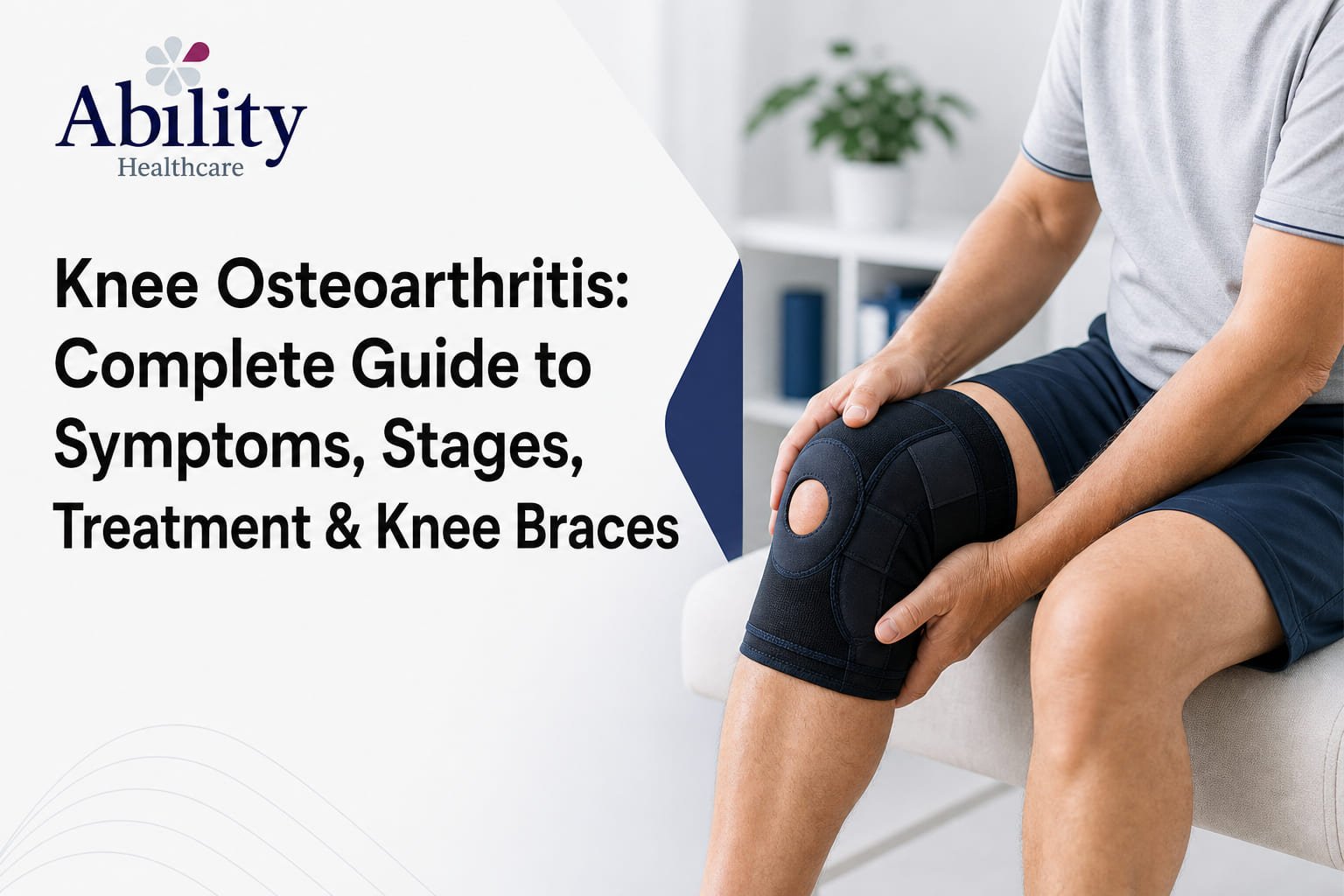
1. Compression sleeves and knee support for osteoarthritis. Elastic or neoprene sleeves that provide warmth, mild compression and improved joint position sense. Useful for grade 1 to early grade 2 symptoms. They do not correct alignment or reduce joint load.
2. Hinged support braces. Sleeves with metal or polycentric hinges on either side. They add side to side stability and are helpful when the knee feels unstable or gives way.
3. Patellofemoral knee brace. Designed for pain behind or around the kneecap. These use a buttress or strap to guide patellar tracking, and suit people whose pain is worst when climbing stairs or standing up from a chair.
4. Unloader or offloader knee brace. The most clinically effective option for single compartment osteoarthritis, explained in the next section.
5. Custom knee brace for osteoarthritis. Built from your own measurements or a scan of your limb. A custom medical grade knee brace for osteoarthritis is recommended when you have significant deformity, an unusual limb shape, or when an off the shelf brace slips or causes pressure points.
Unloader Knee Brace and Offloader Knee Brace: How They Work
An unloader knee brace, also called an offloader knee brace or an offloading brace for knee osteoarthritis, uses a three point leverage system. The frame applies a gentle corrective force that tilts the knee slightly away from the damaged compartment, transferring load onto the healthier side of the joint. For a patient with medial compartment osteoarthritis and bow legged alignment, this means the worn inner side carries measurably less pressure with every step.
Patients typically report reduced pain during walking, improved confidence on uneven ground, longer pain free walking distance, and in many cases the ability to postpone surgery. Össur’s clinical information on unloader bracing for osteoarthritis pain explains the biomechanics in more detail.
Unloader knee brace fitting is not a retail transaction. It requires assessment of your standing alignment, your X-ray grade, accurate circumferential and length measurements, correct hinge placement at the joint line, and then progressive tuning of the corrective force over the following weeks. A brace that is fitted from a size chart alone will usually migrate down the leg and stop working.
Unloader knee brace side effects are generally minor and manageable. They can include mild skin irritation, redness at strap contact points, slipping if the fit is not precise, and temporary muscle soreness during the first two weeks as your gait adjusts. Correct sizing, a graduated wearing schedule and proper skin care resolve nearly all of these. Report any persistent numbness, tingling or breaks in the skin to your orthotist.
Össur Knee Brace Options We Fit
At Ability Healthcare, we fit Össur bracing, a globally established Icelandic manufacturer of orthotic and prosthetic devices.
- Össur Unloader One: the flagship Össur unloader knee brace, using dual dynamic force straps and a dial system so the corrective force can be adjusted as your comfort improves. Lightweight and suitable for daily wear.
- Össur Unloader Fit: a softer, lower profile offloading option for patients with mild to moderate osteoarthritis who want something discreet under clothing.
- Össur Rebound Dual: a rigid hinged brace for instability and ligament support, often used alongside osteoarthritis management.
An Össur knee brace price varies by model and by whether an off the shelf or custom version is required. Speak to our team for current pricing and to confirm which model matches your grade.
How to Choose a Knee Brace for Osteoarthritis
Six questions determine the right choice:
- Which compartment is affected? Medial or lateral single compartment damage points strongly toward an unloader. Kneecap pain points toward a patellofemoral brace.
- What is your grade? Grades 2 and 3 respond best to offloading. Grade 4 can still benefit, particularly while awaiting surgery.
- How active are you? If you need reliable knee support for walking with osteoarthritis over long distances, a rigid offloading frame will outperform a sleeve.
- Is your limb shape standard? Significant deformity or a tapered thigh usually calls for a custom brace.
- How long to wear a knee brace for osteoarthritis? Most patients begin with one to two hours a day, increasing by an hour or two each day. Within two weeks, many wear it for all standing and walking activity. It should be removed for sleeping unless your clinician advises otherwise.
- Who is wearing it? A knee brace for elderly with arthritis must be easy to put on independently, so look for simple strap systems and light weight over maximum rigidity.
Knee Brace for Osteoarthritis Price in India
Cost varies widely by category. As an indicative guide:
| Brace type | Indicative range |
| Compression sleeve or basic support | ₹800 to ₹3,000 |
| Hinged support brace | ₹3,000 to ₹10,000 |
| Off the shelf offloading brace for knee | ₹25,000 upward |
| Premium unloader brace (Össur and similar) | ₹50,000 upward |
| Custom fabricated brace | Quoted after assessment |
These are broad ranges, not quotations. Knee brace price in Lucknow at our centre depends on the model selected and whether customisation is needed. We give you a written estimate after your assessment, with no obligation to purchase.
A word of caution on buying online: a low cost sleeve bought without assessment cannot correct alignment, and an expensive unloader bought in the wrong size will slip and disappoint you. The device is only as good as the fitting.
Osteoarthritis Treatment in Lucknow: Where to Buy a Knee Brace
Ability Healthcare is a dedicated artificial limb, orthotics and prosthetics centre in Lucknow, Uttar Pradesh. If you are searching for where to buy a knee brace in Lucknow, or have been referred by a knee specialist in Lucknow for bracing, our certified prosthetist and orthotist team provides:
- Full standing alignment and gait assessment
- Review of your X-ray grade and compartment involvement
- Guidance on the right brace category for your specific knee
- Precise measurement, fitting and force tuning
- Follow up reviews, strap replacement and adjustments as your condition changes
We fit both off the shelf and custom devices, and we will tell you honestly if a simple support is all you need.
Frequently Asked Questions
Can knee osteoarthritis be cured?
Osteoarthritis cannot currently be reversed, because lost cartilage does not regrow. However, symptoms can be controlled well and progression can be slowed with weight management, exercise, appropriate medication and offloading support.
Does a knee brace really help osteoarthritis?
For single compartment osteoarthritis, a properly fitted unloader brace mechanically reduces load on the damaged side of the joint. Patients commonly report less pain and longer walking distance. A generic sleeve provides comfort and warmth but does not change joint loading.
Can a knee brace help me avoid knee replacement surgery?
Bracing does not repair the joint, but by reducing pain and improving function it can allow many patients to postpone surgery, sometimes for years. Whether that applies to you depends on your grade, alignment and symptoms.
How long does it take to feel a difference?
Many patients notice reduced pain within the first week of consistent wear. Full benefit usually appears at four to six weeks, once the wearing schedule is complete and the force setting has been fine tuned.
Can I wear an unloader brace all day?
Yes, once you have completed the graduated break in period. Most patients wear it during all walking and standing activity and remove it at night.
Is a custom brace always better?
No. Off the shelf braces work well for standard limb shapes. Custom devices are worth the additional cost when there is significant deformity, an unusual limb contour, or when off the shelf options have failed to stay in place.
The Next Step
Knee osteoarthritis is manageable, and surgery is not the only path. The most useful thing you can do is find out exactly which compartment is affected and what grade you are at, because that single piece of information decides whether an offloading brace will work for you.
Bring your X-ray to our Lucknow centre for a full assessment with a certified orthotist.
Note: This article is for general information and does not replace individual medical advice. Please consult a qualified clinician about your own knee.