
Improving the Mobility of People with Disabilities!
Personalised prosthetic leg fitting, gait training and follow-up care, so you can get back to walking, working and living on your own terms.
Years Experience
Patients Served
Certified Lab
Standard Components

A custom-made artificial leg, measured, built and aligned by the same team that looks after you once you start walking.

An artificial leg, also called a prosthetic leg or lower limb prosthesis, is a custom-made device that replaces part or all of a leg lost to amputation, injury or a condition present from birth. Many families in India simply call it a duplicate leg or nakli pair. Whatever you call it, the goal is the same: a leg that fits well, feels stable and suits the way you live.
Ability Healthcare is a prosthetics and orthotics clinic in Lucknow, Uttar Pradesh. When you compare any artificial leg company in India, three questions matter most: who measures and fits the leg, which components go into it, and who adjusts it once you start walking. At our clinic the same team handles all three, using 3D scanning, gait analysis and components matched to your amputation level and daily activity.
Whether your amputation followed an accident, diabetes or a limb difference from birth, we explain your options and what a prosthetic leg in India is likely to cost before anything is made. You can read about our clinicians, Dr Kuldeep and Dr Anushree, before your visit.
What you can expect when your prosthetic leg is made and fitted with us
State-of-the-art fabrication technology with international quality standards
Premium components from leading international manufacturers
3D scanning and gait analysis to fine-tune fit and alignment
Custom solutions tailored to your lifestyle and activity goals
Prosthetic leg options for every amputation level, from partial foot to hip, and for every stage of life

Hip disarticulation prosthesis is an advanced prosthetic solution designed for individuals who have undergone amputation at the hip joint level. This complex prosthetic system replaces the entire lower limb, including the hip, thigh, knee, and foot.
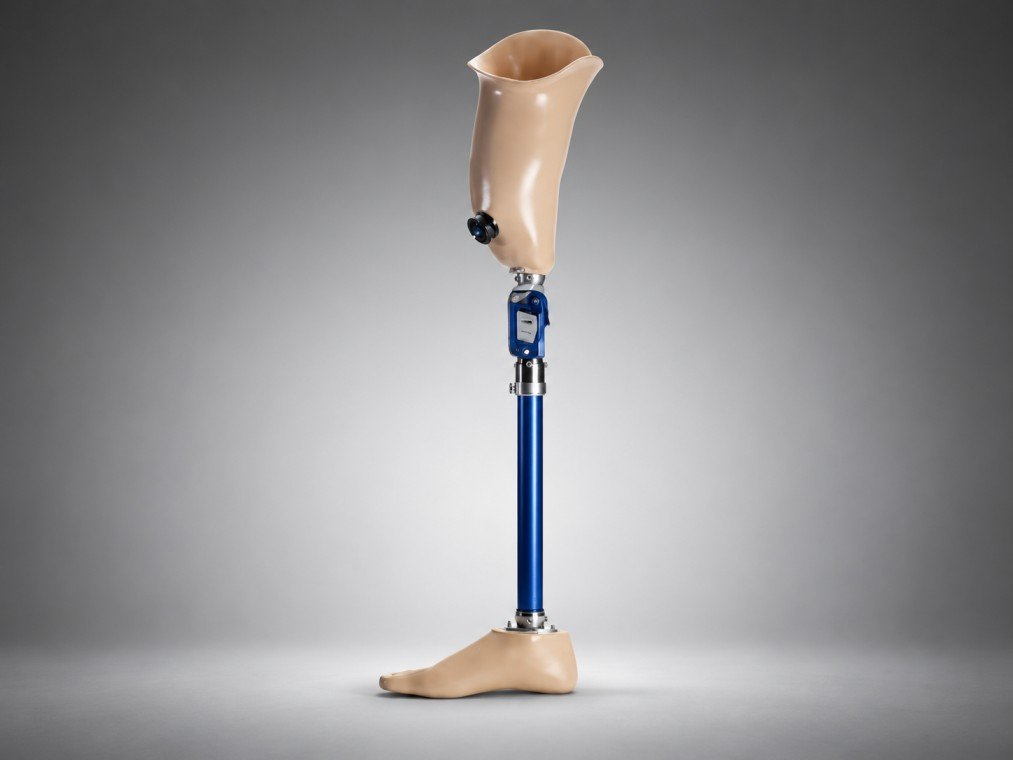
Above knee prosthesis (transfemoral prosthesis) is designed for people whose amputation is above the knee joint. It includes a custom socket, an artificial knee joint, a shin section and a prosthetic foot. The knee joint is the biggest factor in the artificial leg above knee price, so we match it to how and where you walk.

A knee disarticulation prosthesis is for people whose amputation passes through the knee joint, leaving the whole thigh bone in place. Because the end of the thigh can often take some body weight, the socket can be shorter and more comfortable to sit in. The thigh section is longer than on the other side, so we use low-profile knee joints made for this level to keep the knees as even as possible.
Below knee prosthesis (transtibial prosthesis) is the most common type of lower limb prosthesis, designed for individuals who have undergone amputation below the knee joint. This prosthetic preserves the natural knee function, allowing for more efficient walking.

A partial foot prosthesis restores the shape and function of the foot after toe, ray, transmetatarsal or mid-foot amputation. It is often needed after diabetic foot surgery. Depending on how much of the foot remains, it may be a custom silicone restoration, a shoe filler with a carbon fibre footplate, or a slipper or ankle-height socket. See also our prosthetic foot options.
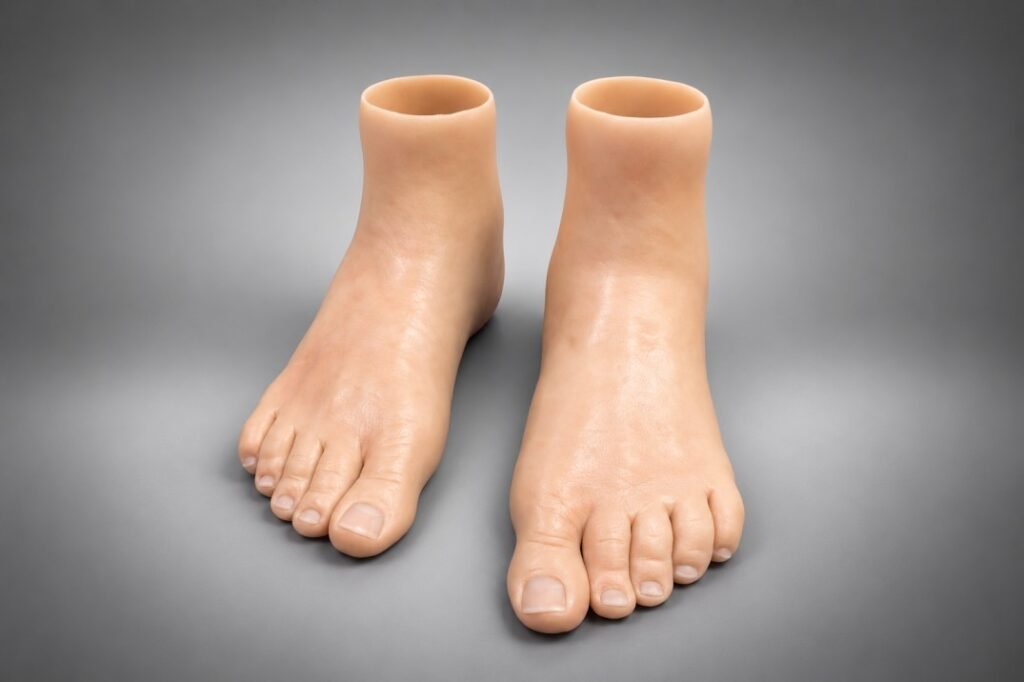
Paediatric prosthetics are artificial limbs designed for children with a limb difference from birth or after amputation. They are built to be adjusted as your child grows, to cope with plenty of play, and to support each stage of development. See our child prosthetics page for more.

Blade feet (running blades) are J-shaped carbon fibre feet made for running and sprinting. They store energy as you land and give it back as you push off. They are built for sport rather than everyday walking. Find out more on our sports prosthetics page.

A bionic leg uses a microprocessor-controlled knee and, in some systems, a microprocessor or powered ankle. Sensors read your walking speed and the ground under you, then change how the joint moves as you walk. That helps on slopes, stairs and uneven roads. Many people search for this as a robotic leg. Not everyone needs one, so we check your strength, balance and daily routine first. See our microprocessor knee page for model details.

The Symbionic Leg from Össur pairs a microprocessor knee with a powered, motorised ankle in one system for above knee users. The ankle lifts the toe as the leg swings through, which lowers the chance of tripping, while the knee adjusts its resistance as you walk.

Socket fabrication is the most important part of any prosthetic fitting. The socket is where your residual limb meets the prosthesis, so a good fit protects your skin and gives you control of the leg. We make sockets in thermoplastics, composites and carbon fibre. A carbon fibre artificial leg is lighter and stiffer, which many active users prefer.

A prosthetic liner is a soft sleeve worn directly on the residual limb. It cushions the limb, protects the skin from rubbing and pressure, and in many systems helps hold the prosthesis on. Liners wear out, so ask for the silicone liner price in your quote as a regular running cost.

Diabetes is one of the common reasons for leg amputation in India. An artificial leg can still help you walk again, but a few things need extra care. We plan around them from your first visit.
Wounds can take longer to heal with diabetes, so we agree the timing of your first fitting with your surgeon rather than working to a fixed date.
Soft silicone or gel liners and pressure-relieving socket shapes help protect skin that may heal slowly or have reduced feeling.
Your limb size can change with fluid levels and blood sugar, so we review the fit more often in the first months and adjust the socket as needed.
We check your remaining foot at each visit and can suggest footwear or custom insoles to reduce pressure on it.
We show you and your family what to look for on the residual limb each day, and when a red mark or blister needs attention.
Your fitting plan fits around the advice of your diabetes doctor and physiotherapist, so everyone is working towards the same goals.
This is general information, not medical advice. Your surgeon and diabetes doctor will guide you on your own situation. For a week-by-week view of recovery, read our guide to life after leg amputation.
Careful fitting, honest advice and support long after your first steps
More than 15 years of work in lower and upper limb prosthetics, with patients coming to us from across Uttar Pradesh and other parts of India.
We work with components from Ottobock, Össur, Blatchford and other established manufacturers, chosen to suit your needs and budget.
Consultation, fitting, alignment and gait training happen under one roof, with prosthetists and physiotherapists guiding each step.
Written quotes, flexible payment options and aftercare that covers maintenance and adjustments for your prosthetic leg.
Everyday goals our patients work towards, from first steps to getting back to work and family life.


A 6-step process built around fit, comfort and the way you want to move
A medical review, residual limb check, lifestyle assessment and a conversation about your goals. Our prosthetists take detailed measurements to start your custom design.
3D scanning records the exact shape of your residual limb. Our CAD/CAM system then designs a socket that spreads pressure evenly, before anything is fabricated.
We help you choose the foot, knee and other parts based on your amputation level, body weight, activity and budget. This is where we explain options such as a hydraulic or microprocessor knee and what each adds to the price. We work with manufacturers including Ottobock, Össur and Blatchford.
A check socket is fitted first to confirm comfort. We then adjust alignment until your weight is balanced and your walking pattern looks right, and keep refining until the fit feels comfortable.
A physiotherapy programme that teaches you to walk safely with your new prosthesis. Exercises build strength, balance and confidence on different surfaces.
Regular check-ups to review fit, function and changes in limb size, with adjustments and servicing to keep your prosthesis working well.
What decides your prosthetic leg price, and what each price band usually includes. These are guide figures; your final price is confirmed in a written quote after assessment.
Entry-level prosthetics
Suits most daily walkers
For active users
Top-end bionic systems
*Guide prices, last reviewed September 2026. Your final price depends on the components, customisation and clinical needs, and is confirmed in writing after assessment.
Every patient is different. We offer a free consultation and flexible payment options, so you get an accurate artificial leg cost estimate based on your amputation level, needs and goals before you decide.
The price guide above shows the overall range. Here is how the price usually changes with the type of leg, the knee joint and the brand of components.
| Type of artificial leg | What mostly drives the price | Usual price band* |
|---|---|---|
| Partial foot prosthesis | Silicone restoration or carbon fibre footplate, and how much of the foot remains | Quoted after assessment |
| Below knee prosthesis | Socket design, liner and prosthetic foot | Basic to Standard; Advanced if a microprocessor foot is chosen |
| Knee disarticulation prosthesis | Low-profile knee joint and end-bearing socket | Basic to Advanced, depending on the knee |
| Above knee prosthesis | Knee joint: mechanical, hydraulic or microprocessor | Basic to Advanced; Bionic for powered systems |
| Hip disarticulation prosthesis | Hip joint, knee joint and pelvic socket | Standard and above |
A below knee prosthesis price in India is usually lower because there is no knee joint to pay for; most of the cost is in the socket, liner and foot. The above knee prosthesis price in India depends mainly on the knee. The same socket can be paired with a simple mechanical knee or a microprocessor knee, which is why the artificial leg above knee price varies so widely.
| Knee joint | Best suited to | Relative price | Usual price band* |
|---|---|---|---|
| Mechanical (single-axis or polycentric) | Walking at one steady speed, lower activity | Lowest | Basic |
| Hydraulic knee joint | Walking at different speeds, moderate activity | Mid-range | Standard |
| Microprocessor knee | Slopes, stairs, uneven ground and higher activity | Highest | Advanced to Bionic |
The hydraulic knee joint price sits between a mechanical and a microprocessor knee, and many daily walkers find it a practical balance of control and cost. We explain the prosthetic knee joint price of each option you are considering before you decide.
A bionic leg sits in the Advanced band (₹5 lakh to ₹12 lakh) when it uses a microprocessor knee, and in the Bionic band (₹12 lakh or more) for top-end systems such as a microprocessor knee paired with a powered ankle. The robotic leg price in India follows the same bands, because a robotic leg usually means the same technology. Servicing and battery care add to the long-term cost.
Brand alone does not set the price. The Ottobock prosthetic leg price in India covers everything from basic mechanical parts to the C-Leg and Genium, so an Ottobock artificial leg price can fall in any band. The same is true of the Ossur prosthetic leg price in India, as Össur also makes components at several levels. Your quote lists each component by name, with warranty and servicing details, so you can compare like with like.
Liners usually need replacing every 6 to 12 months, and sockets every 1 to 3 years as your limb changes. Ask for the silicone liner price and expected servicing costs in your quote, so you can plan for the years after your first fitting, not just the fitting itself.
We offer flexible payment options. If you would like to spread the cost, ask our team which prosthetic leg EMI or instalment plans are available when you receive your quote. Availability depends on the payment provider.
*Bands refer to the price guide above: Basic ₹80K to ₹2L, Standard ₹2L to ₹5L, Advanced ₹5L to ₹12L, Bionic ₹12L+. Guide figures only, last reviewed September 2026.
Hi I am surendra yadav
It was an awesome experience with ability health care.The crew members and Dr Kuldeep , Dr Anushree so nice and humble .
Really I m very happy with our personal experience with ability health care .

I have had a very good overall experience with Ablity health care and Dr. Anushree. I have been using the arch support for about an year now and it has helped me with the heel pain I was suffering from.

Anamika Gupta
Had a very good experience in ability health care.Got my above knee Prosthetic leg & I’m very comfortable & happy with the fitment.Thanks to Dr. Kuldeep & Dr. Annushree.

SHOURABH KUMAR
Hi this is Rishi it was good experience with Ability health care.As for as Dr.Kuldeep is concerned he is a to good, responsible & experienced person. & Dr.Anushree is also caring and humble.
Really it was great experience.

Mahendra Kumar
My self utkarsh we had a best experience in ability health care bundle of thanks to all the staff and specially Dr. anushree mam she helped us and now my brother can walk easily thank you again 😊👍🏻

Som Awasthi
In Ability Healthcare, artificial hands with very good sensor are fitted. Many thanks to Dr. Kuldeep Singh and Dr. Anushree Singh. Now we are able to do all our work again.
Do visit Ability Healthcare Lucknow for artificial hands fitting.

Sanjay Kumar
Reviews shared by patients and families who have visited our clinic
Browse the components and devices our team commonly fits for artificial legs. Every product is customised to the patient after an assessment, so speak to us before choosing.
Answers to common questions about artificial legs, prosthetic leg prices and aftercare
An artificial leg in India usually costs from about ₹80,000 to ₹12 lakh, and bionic systems can cost ₹12 lakh or more. A basic below knee prosthesis sits at the lower end of that range, while an above knee leg with a microprocessor knee sits near the top. The price depends on your amputation level, the knee and foot you choose, the liner and any customisation. These figures match the price guide on this page. We offer a free consultation and a written quote after assessment, along with flexible payment options.
Many people can, with the right components and training. Walking long distances, cycling, swimming and sport are all possible for many prosthetic leg users. Driving is often possible with a below knee prosthesis and sometimes with an above knee prosthesis, usually with car adaptations and after a proper driving assessment. Your goals guide the components we suggest.
Most people are ready for a first fitting around 6 to 12 weeks after surgery, once the wound has healed and swelling has settled. Healing can take longer after a diabetes-related amputation. We can start earlier with pre-prosthetic care, such as shaping the limb with compression, strengthening and balance work. Your surgeon and our team agree the timing together, as it depends on healing, general health and amputation level.
Yes. A bionic leg is available in India, including microprocessor knees such as the Ottobock C-Leg and Genium, and systems that pair a microprocessor knee with a powered ankle. They use sensors to adjust as you walk, which helps on slopes, stairs and uneven ground. In our price guide they sit in the Advanced band (₹5 lakh to ₹12 lakh) and the Bionic band (₹12 lakh or more). They are not right for everyone, so we assess you before recommending one.
A well-maintained prosthetic leg often lasts 3 to 5 years, although parts wear at different rates. Sockets may need replacing every 1 to 3 years as the limb changes shape. Feet and knees often last 3 to 5 years with good care, and liners usually need replacing every 6 to 12 months. Microprocessor parts can last 5 to 7 years. How hard you use the leg, changes in body weight and regular servicing all make a difference.
Yes. Physiotherapy is a key part of learning to use a prosthesis. Our rehabilitation covers gait training, strength and balance work, and practice on stairs, slopes and everyday tasks. Many people need several weeks of regular sessions, followed by periodic reviews as they get more confident.
Yes. A waterproof prosthetic leg uses water-resistant feet, knees and covers, so you can shower, bathe or swim without worrying about damage. Some people keep a separate leg just for water. Not every knee or foot is waterproof, so we check the water rating of each component with you before you choose.
We offer flexible payment options. If you would like to spread the cost, ask our team which prosthetic leg EMI or instalment plans are available when you receive your quote. Availability depends on the payment provider.
Yes, many people with diabetes walk well with an artificial leg. Healing can take longer, the limb may change size more often, and the skin needs daily checks, so we plan the fitting with your surgeon and diabetes doctor. The section on artificial legs for diabetic amputees above explains what we do differently.
Our team is here to help you regain mobility with comfort and confidence. Take the first step towards independence today.
Plot No. 9A, Kaushalpuri, Khargapur, Gomti Nagar Extension, Lucknow - 226010
+91 9119999158

Specialist in comprehensive prosthetic & orthotic care, bridging technological innovation with patient-centred rehabilitation
Hi I am surendra yadav
It was an awesome experience with ability health care.The crew members and Dr Kuldeep , Dr Anushree so nice and humble .
I have had a very good overall experience with Ablity health care and Dr. Anushree. I have been using the arch support for about an year now and it has helped me with the heel pain I was suffering from.
– Anamika Gupta
Had a very good experience in ability health care.Got my above knee Prosthetic leg & I’m very comfortable & happy with the fitment.Thanks to Dr. Kuldeep & Dr. Annushree.
– SHOURABH KUMAR