Can You Get an Artificial Arm After Shoulder-Level Amputation?
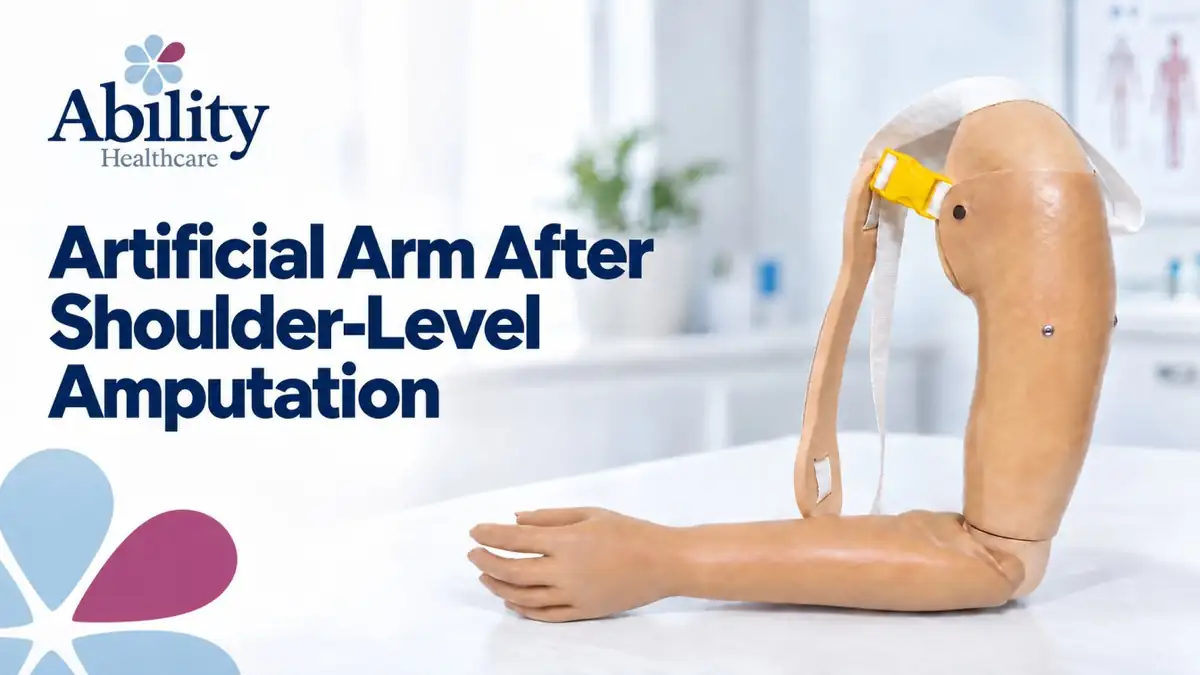
Yes, it is possible to get an artificial arm after a shoulder-level amputation. Depending on your surgical condition, an appropriate shoulder-level prosthesis may help restore the appearance of the missing arm, support selected daily activities and improve independence.
A shoulder-level prosthetic arm generally replaces several missing anatomical segments, including the shoulder, elbow, wrist and hand. It may be designed as a cosmetic or passive arm, a body-powered prosthesis controlled through a harness and cable, a myoelectric prosthesis operated using muscle signals, or a hybrid system combining different control mechanisms.
However, choosing an artificial arm after shoulder amputation is more complex than choosing an above-elbow or below-elbow prosthesis. The available anatomical structures, socket suspension, remaining muscle activity, control options, weight and rehabilitation requirements all influence the final design.
Indicative artificial arm prices in India can range from approximately ₹1 lakh for certain cosmetic configurations to ₹10 lakh or more for advanced powered configurations. Actual costs depend on the components and individual requirements.
This guide explains the different types of shoulder-level prostheses, their functional capabilities, fitting procedures, costs and possible government assistance in India.
Lost Your Arm at Shoulder Level?
An appropriately selected prosthetic solution may help restore appearance, support selected daily activities and improve independence.
Book Your Prosthetic Assessment at Ability Healthcare
What Does Shoulder-Level Amputation Mean?
Shoulder-level amputation refers to the loss of the upper limb at or around the shoulder region. Two important surgical levels are shoulder disarticulation and forequarter amputation.
Understanding the difference is essential because the remaining anatomical structures influence prosthetic socket design, suspension and control.
1. Shoulder Disarticulation
Shoulder disarticulation involves removal of the upper limb through the shoulder joint.
The scapula (shoulder blade) generally remains, although the condition of surrounding soft tissues and the remaining shoulder structures varies between individuals.
A prosthetic socket is designed around the available chest and shoulder anatomy. Depending on the individual, the remaining scapular and trunk movements may also contribute to prosthetic suspension and control.
2. Forequarter Amputation
Forequarter amputation, also known as interscapulothoracic amputation, involves removal of the upper limb along with the scapula and part or all of the clavicle.
This creates a more challenging prosthetic fitting situation because the normal shoulder contour and important anatomical suspension structures are absent.
A forequarter amputation prosthesis generally requires a specially designed chest-wall socket and suspension arrangement.
The prosthetic design may primarily aim to restore the appearance and contour of the missing shoulder and arm, with functional capabilities depending on the selected components.
Difference Between Above-Elbow, Shoulder Disarticulation and Forequarter Amputation
| Amputation level | Remaining anatomy | Prosthetic components required |
|---|---|---|
| Above elbow (transhumeral) | Shoulder joint and part of upper arm | Elbow, wrist and hand |
| Shoulder disarticulation | Scapula generally retained | Shoulder unit, elbow, wrist and hand |
| Forequarter amputation | Scapula and part or all of clavicle removed | Chest-wall suspension, shoulder unit, elbow, wrist and hand |
If part of your upper arm remains, you may be suitable for an above-elbow prosthesis rather than a shoulder-level prosthesis.
Read our guide to body-powered vs bionic arm options.
Types of Artificial Arm After Shoulder Amputation
A full arm prosthesis may consist of a custom socket, shoulder joint, elbow unit, wrist unit and terminal device.
The terminal device may be a mechanical hand, hook or externally powered prosthetic hand.
Four broad types of artificial arms may be considered depending on the patient’s anatomy, functional requirements and available control options.
1. Cosmetic or Passive Artificial Arm
A cosmetic artificial arm is designed primarily to restore the appearance of the missing limb.
It generally consists of a custom socket, arm structure, passive joints and a cosmetic hand or glove.
Key features:
- Restores the external appearance of the missing arm.
- Helps maintain body symmetry and clothing appearance.
- Can assist in stabilising or supporting lightweight objects.
- Generally requires less training than functional prostheses.
- Does not provide powered gripping or active elbow movement.
A passive prosthesis can be particularly useful for individuals who prioritise appearance, comfort and ease of use.
Custom silicone covers and cosmetic gloves can improve the natural appearance of the artificial arm.
2. Body-Powered Shoulder Prosthesis
A body-powered artificial arm uses a mechanical harness and cable system to operate selected prosthetic components.
Body movements generate the force required to pull the cable, which can operate a mechanical elbow or terminal device.
At shoulder disarticulation level, the available body movements for operating the prosthesis are more limited than in below-elbow and above-elbow fittings.
The control system must be designed according to the patient’s remaining anatomy and available movements.
Important considerations:
- Available shoulder, scapular and trunk movements.
- Cable excursion and the force generated during movement.
- Harness configuration and suspension.
- Mechanical advantage and operating force.
- Patient comfort and endurance.
Not every shoulder-level amputee can successfully operate the same body-powered configuration. An individual assessment and practical trial are important before selecting this system.
Body-powered systems may be useful for selected functional activities, but their effectiveness depends on the patient’s ability to generate adequate control movements.
3. Myoelectric Artificial Arm (Externally Powered Prosthesis)
A myoelectric arm prosthesis uses electrical signals generated by muscle activity to operate powered components.
Sensors placed on the skin detect small electrical signals produced when selected remaining muscles contract.
These signals are processed by the control system and used to operate motors in the prosthetic hand, wrist or elbow, depending on the configuration.
At shoulder disarticulation level, suitable control signals may be obtained from available muscles in the chest, back or shoulder region.
However, the number and quality of available signals vary between patients.
Key features:
- Battery-powered operation.
- Muscle-signal-based control.
- Powered hand or elbow, depending on the selected system.
- No conventional mechanical control cable required for the powered functions.
- Requires practice, signal training and regular maintenance.
A myoelectric arm does not automatically provide independent control of every joint.
Some systems use sequential switching between functions, while more advanced systems may offer additional control strategies. Simultaneous independent movement depends on the available signals, control system and prosthetic configuration.
Myoelectric systems may be suitable for selected patients who require active gripping and can manage the additional weight, training and maintenance.
Is Nerve Surgery (TMR) Required for a Myoelectric Arm?
No. Targeted Muscle Reinnervation (TMR) is not required for every person receiving a myoelectric prosthesis.
TMR is a specialised surgical procedure in which selected nerves that previously supplied the missing arm muscles are transferred to suitable remaining muscles.
The objective is to create additional muscle signals that may improve prosthetic control.
TMR may be considered in selected patients with high-level upper-limb amputations, including shoulder disarticulation.
However, it requires surgical evaluation, suitable recipient muscles and an appropriate rehabilitation plan.
Many myoelectric prosthesis users operate their devices using surface electrodes without undergoing TMR.
The decision to perform TMR must be made by the treating surgical team.
4. Hybrid Artificial Arm
A hybrid prosthesis combines body-powered and externally powered components.
For example, it may use a mechanically controlled elbow and an electrically powered hand.
The objective is to balance functional capability, weight, control requirements and cost.
Hybrid systems may be considered when a fully powered configuration is not necessary or practical.
The appropriate combination depends on the available anatomy, control strategy and functional goals.
Comparison of Different Shoulder-Level Prosthetic Arms
| Prosthesis type | Control mechanism | Main advantage | Main limitation |
|---|---|---|---|
| Cosmetic/passive | Manually positioned | Lightweight and natural appearance | No active gripping |
| Body-powered | Harness and cable | Mechanical control without batteries | Requires adequate body movement |
| Myoelectric | Muscle signals and batteries | Powered hand or elbow movement | Weight, cost and training |
| Hybrid | Combination of mechanical and powered controls | Flexible configuration | More complex fitting |
What Can a Shoulder-Level Prosthesis Actually Do?
Whether you are considering your first prosthetic arm after amputation or a replacement, it is important to understand the realistic capabilities of a shoulder-level artificial arm.
A prosthesis cannot completely reproduce the movement, sensation, strength, coordination and dexterity of a natural arm.
Its function depends on the components, control system and individual rehabilitation outcomes.
Depending on the design, it may help with:
- Restoring the external appearance of the missing arm.
- Holding and stabilising lightweight objects.
- Supporting selected two-handed activities.
- Positioning objects using a mechanical or powered terminal device.
- Improving body symmetry under clothing.
- Supporting selected occupational and daily activities.
The actual functional benefit varies significantly between patients.
Cosmetic Appearance vs Functional Artificial Arm
One of the most important decisions when selecting a prosthesis is whether the priority is appearance, function or a combination of both.
Appearance-focused prosthesis
A cosmetic artificial arm is suitable for people who primarily want to restore the natural outline of the shoulder and arm. It is generally lighter and easier to manage.
Function-focused prosthesis
Body-powered, myoelectric and hybrid prostheses offer selected functional capabilities, such as gripping, holding and positioning objects. These systems require more training and may be heavier.
Combination approach
Some individuals may prefer to have a functional prosthesis for selected activities and a lighter cosmetic prosthesis for other situations.
The choice should be based on the individual’s expectations, lifestyle, comfort and functional requirements.
Who Is a Suitable Candidate for a Shoulder-Level Prosthesis?
Not every patient with shoulder-level amputation requires the same type of prosthesis.
A prosthetist evaluates several factors before recommending a suitable system.
Important clinical assessment factors
- Residual anatomy: The available shoulder, chest-wall and scapular structures influence socket design and suspension.
- Skin and scar condition: Skin sensitivity, scar tissue, grafts and soft-tissue condition influence socket comfort.
- Muscle activity: Available muscle contractions and electrical signals help determine the feasibility of myoelectric control.
- Range of movement: Available trunk and shoulder movements may influence mechanical control and positioning.
- Physical endurance: The patient must be able to manage the weight and wear requirements of the selected prosthesis.
- Functional goals: Daily activities, occupation, lifestyle and expectations must be considered.
- Financial considerations: The cost of components, maintenance and rehabilitation must be discussed before final selection.
A detailed prosthetic assessment helps identify whether a cosmetic, body-powered, myoelectric or hybrid solution is appropriate.
Can You Drive, Work or Perform Daily Activities With an Artificial Arm?
Some individuals can perform selected daily activities with a shoulder-level prosthesis, depending on their functional ability and the prosthetic system.
However, an artificial arm does not automatically restore the ability to perform every activity.
Daily activities: Patients can practise dressing, carrying, eating and stabilising objects with appropriate rehabilitation strategies.
Work: Occupational requirements should be assessed individually. Certain activities may require workplace modifications, assistive devices or alternative techniques.
Driving: Driving suitability must be assessed according to the individual’s functional ability, vehicle controls and applicable licensing requirements. Consult the relevant Regional Transport Office and obtain appropriate professional advice before driving.
Rehabilitation may also teach individuals to perform many tasks without their prosthesis using one-handed techniques and adaptive equipment.
How Is a Shoulder Disarticulation Prosthesis Fitted?
A shoulder-level prosthetic fitting requires detailed assessment, customised socket fabrication, component selection and rehabilitation.
The general process includes the following stages.
Step 1: Clinical Assessment
The prosthetist evaluates:
- Amputation level and residual anatomy.
- Skin and scar condition.
- Available muscle activity.
- Posture and trunk movements.
- Functional goals and expectations.
- Suitable prosthetic options.
Step 2: Casting or 3D Scanning
A plaster cast or appropriate digital scan is taken to capture the shape of the shoulder and chest-wall region.
This information is used to develop the customised prosthetic socket.
Read more about prosthetic socket fabrication.
Step 3: Diagnostic or Test Socket
A trial socket may be fabricated to assess:
- Socket fit and suspension.
- Pressure distribution.
- Comfort and stability.
- Available range of movement.
- Overall prosthetic positioning.
Necessary modifications are made before final fabrication.
Step 4: Component Selection and Control Setup
The shoulder joint, elbow unit, wrist and terminal device are selected according to the prescription.
For body-powered systems, the harness and cable arrangement are adjusted.
For myoelectric systems, available muscle signals are evaluated and electrodes are positioned and calibrated.
Step 5: Alignment and Final Fabrication
The prosthesis is aligned to achieve appropriate length, positioning and functional balance.
The cosmetic appearance and final component configuration are also checked.
Step 6: Prosthetic Training
The patient receives guidance on:
- Donning and doffing.
- Operating the prosthesis.
- Object stabilisation and gripping.
- Functional positioning.
- Skin care and prosthetic maintenance.
- Safe use during daily activities.
Occupational therapy may be useful for developing practical daily-living strategies.
Step 7: Follow-Up and Adjustments
Regular follow-up is important to evaluate socket comfort, skin condition, component functioning and prosthetic control.
Adjustments may be required as the patient adapts to the prosthesis.
Successful upper-limb rehabilitation is a continuing process rather than simply the delivery of an artificial arm.
Prosthetic Shoulder Joints
A prosthetic shoulder joint helps position the artificial arm.
Conventional shoulder units are often passive, meaning the user positions the arm manually with the other hand or through an available positioning mechanism.
According to ALIMCO, two shoulder joint types are manufactured:
1. Bulkhead-type shoulder joint
Permits passive flexion and extension at the shoulder.
2. Universal shoulder joint
Permits passive flexion and extension, along with passive abduction and adduction.
These movements are manually achieved and are not powered shoulder movements.
The joint type, range of movement and locking mechanism vary according to the manufacturer and model.
The prosthetist selects the appropriate component based on the amputation level and functional requirements.
Artificial Arm Price in India After Shoulder Amputation
The artificial arm price in India depends on the level of amputation, socket design, component selection and technology used.
A shoulder-level prosthesis may cost more than a conventional above-elbow prosthesis because it requires additional components and a more extensive socket and suspension arrangement.
Indicative Artificial Arm Cost in India
| Type of prosthesis | Indicative estimated price |
|---|---|
| Cosmetic or passive full arm | ₹1,00,000–₹2,50,000 |
| Body-powered full arm | ₹2,00,000–₹4,00,000 |
| Hybrid full arm | ₹4,00,000–₹10,00,000 |
| Myoelectric full arm | ₹10,00,000 onwards |
| Above-elbow body-powered arm (comparison) | ₹40,000–₹1,50,000 |
Important: These are broad indicative estimates for general guidance, not fixed quotations or government-approved rates. Actual costs depend on the amputation level, socket design, shoulder and elbow mechanisms, powered components, terminal device, customisation, fitting and rehabilitation requirements. An individual clinical assessment and component quotation are necessary to determine the final price.
Factors Affecting Prosthetic Arm Cost
1. Level of amputation
A forequarter amputation generally requires more extensive socket and suspension considerations than a conventional above-elbow fitting.
2. Prosthetic components
Mechanical and imported components from manufacturers such as Ottobock and Össur may have different prices and specifications.
3. Powered components
Myoelectric hands, powered elbows, batteries, sensors and chargers increase the overall cost.
4. Cosmetic finishing
A standard cosmetic glove and a customised silicone cover have different fabrication requirements and costs.
5. Maintenance and rehabilitation
Component servicing, replacement parts, socket adjustments and training should also be considered when evaluating the total cost.
For further information, read our guide to artificial hand price in India.
Government Assistance for Artificial Limbs Through the ADIP Scheme
The Government of India’s Assistance to Persons with Disabilities for Purchase/Fitting of Aids and Appliances (ADIP) Scheme supports access to assistive devices, including certain prosthetic limbs.
The Department of Empowerment of Persons with Disabilities (DEPwD) administers the scheme through authorised implementing agencies.
According to the revised ADIP Scheme guidelines, applicable from 26 September 2024, the general eligibility requirements include:
- Indian citizenship.
- A disability certificate indicating at least 40% disability.
- UDID card or UDID enrolment number.
- Aadhaar card or Aadhaar enrolment number.
- Monthly income of the individual from all sources not exceeding ₹30,000.
Financial Assistance Under ADIP
For eligible general aids and appliances, the guidelines provide:
- Monthly income up to ₹22,500: assistance towards the full cost within applicable scheme limits.
- Monthly income from ₹22,501 to ₹30,000: assistance towards 50% of the cost within applicable scheme limits.
High-End Prosthesis Assistance
The revised guidelines provide assistance of up to ₹30,000 for eligible high-end prostheses for persons with locomotor disabilities having 40% or above disability.
ADIP’s Comprehensive List of Aids and Assistive Devices (9 July 2024) includes passive and body-powered shoulder disarticulation prostheses, for adults and children, in its high-end prosthesis category. It does not list a powered (myoelectric) shoulder-level prosthesis.
High-end prostheses under ADIP are provided only through ALIMCO, National Institutes and Composite Regional Centres.
Therefore, patients considering a shoulder-level or advanced powered prosthesis should confirm the specific approved device category, current financial assistance and implementing-agency requirements before making a purchase decision.
Important scheme-status note: The revised 2024 scheme document specifies a period ending 31 March 2026. The Department’s website continues to publish ADIP information, but patients should confirm the scheme’s applicable continuation and current implementation arrangements after that date.
For further information, contact:
- ALIMCO helpline: 1800 180 5129.
- Nearest District Disability Rehabilitation Centre (DDRC).
- Authorised National Institutes or Composite Regional Centres.
- Official ADIP portal: https://adip.depwd.gov.in/
Government assistance is subject to eligibility, approved device categories, assessment and the applicable scheme conditions. It should not be assumed that the government will cover 50% or 100% of an advanced powered prosthesis costing several lakh rupees.
Living With a Full Arm Prosthesis
Adjusting to a shoulder-level artificial arm requires time, patience and appropriate training.
Some important practices can improve comfort and help maintain the prosthesis.
Build wear time gradually: Begin with the duration recommended by your prosthetist and increase wear time according to comfort and skin tolerance.
Check your skin: Examine the socket contact areas regularly. Persistent redness, irritation or discomfort should be assessed.
Maintain hygiene: Clean the socket and follow the manufacturer’s instructions for maintaining liners, gloves and other components.
Protect the opposite arm: Avoid excessive repetitive strain on the unaffected arm. Use adaptive techniques and equipment when necessary.
Report discomfort early: Socket pressure, skin irritation, neck or trunk strain and pain should be discussed with your rehabilitation team.
Attend follow-up appointments: Periodic checks help maintain socket fit, suspension and component performance.
Artificial Arm in Lucknow at Ability Healthcare
Ability Healthcare is a Prosthetics and Orthotics centre based in Gomti Nagar Extension, Lucknow, with additional clinical locations in Azamgarh, Bareilly and Gorakhpur.
Under the clinical leadership of Dr Kuldeep Singh, Prosthetist and Orthotist, Ability Healthcare focuses on individualised prosthetic assessment, customised socket fabrication, component selection, prosthetic fitting and rehabilitation support.
Our clinical approach considers:
- Assessment of the amputation level and residual anatomy.
- Evaluation of suitable cosmetic and functional prosthetic options.
- Customised socket design and fabrication.
- Selection of appropriate mechanical or powered components.
- Prosthetic alignment and fitting.
- Patient education, training and follow-up.
We work with prosthetic component manufacturers including Ottobock, Össur and Endolite, selecting components according to individual clinical and functional requirements.
If you are looking for an artificial arm or artificial hand in Lucknow, our team can help you understand the available options and the suitability of different prosthetic systems.
Visit our Artificial Hand Clinic in Lucknow or call +91-9119999158 to arrange an assessment.
Frequently Asked Questions
Can you get an artificial arm after shoulder amputation?
Yes. People with shoulder disarticulation and forequarter amputation may be considered for cosmetic, body-powered, myoelectric or hybrid prosthetic arms. The suitable design depends on the remaining anatomy, available control signals, functional goals and clinical assessment.
Will an artificial arm work like a natural arm?
No. Current prosthetic technology cannot completely reproduce the sensation, strength, dexterity and coordinated movements of a natural arm. However, an appropriately selected prosthesis may restore appearance and support selected functional activities.
What is the difference between shoulder disarticulation and forequarter amputation?
Shoulder disarticulation involves removal of the arm through the shoulder joint, with the scapula generally remaining. Forequarter amputation removes the arm along with the scapula and part or all of the clavicle. This difference significantly affects socket design and prosthetic suspension.
Which artificial arm is best after shoulder amputation?
There is no single best prosthetic arm for every patient. Cosmetic, body-powered, myoelectric and hybrid systems each have different advantages and limitations. The appropriate choice depends on clinical findings, lifestyle, functional goals, comfort and budget.
How heavy is a shoulder-level prosthetic arm?
The weight depends on the components and construction. Cosmetic systems may be lighter, while powered systems may add weight through motors, batteries and electronic components. The overall weight distribution and suspension are important factors during assessment.
How long does prosthetic arm fitting take?
The fitting process may take several weeks or longer, depending on wound healing, residual-limb condition, socket design, component availability, trial fitting and rehabilitation requirements. Powered systems may also require additional training sessions.
What is the bionic arm price in India?
The cost of a bionic arm depends on the level of amputation, powered hand and elbow components, technology and customisation. Advanced configurations may cost several lakh rupees or more. A clinical assessment and component quotation are necessary for an accurate estimate.
Is there a government scheme for a free artificial arm in India?
The ADIP Scheme provides financial assistance for eligible assistive devices, including certain artificial limbs. Eligibility, approved device categories and subsidy limits apply. A powered shoulder-level prosthesis is not automatically covered. Contact an authorised implementing agency for confirmation.
Can I use a myoelectric arm without TMR surgery?
Yes. Many myoelectric prostheses use surface electrodes placed over suitable remaining muscles. TMR is a separate surgical procedure that may be considered in selected patients to improve available control signals. It is not mandatory for every myoelectric user.
Can I drive with a shoulder-level artificial arm?
Some individuals may be able to drive, depending on their functional ability, vehicle configuration and applicable licensing requirements. An appropriate assessment and confirmation of legal requirements are necessary before driving.
कंधे से कृत्रिम हाथ: अक्सर पूछे जाने वाले सवाल
Kandhe se kata hua haath: kya artificial haath lag sakta hai?
हाँ। कंधे से हाथ कटने के बाद भी कृत्रिम हाथ लगाया जा सकता है। इसके लिए मरीज की स्थिति के अनुसार कॉस्मेटिक, केबल वाला बॉडी-पावर्ड, मांसपेशियों के संकेत से चलने वाला मायोइलेक्ट्रिक या हाइब्रिड हाथ चुना जा सकता है।
Kandhe se artificial haath lagwane ka kharcha kitna hai?
कंधे के स्तर पर कृत्रिम हाथ की कीमत लगभग ₹1 लाख से शुरू होकर ₹10 लाख या उससे अधिक तक जा सकती है। सही कीमत कृत्रिम हाथ के प्रकार, तकनीक और मरीज की जाँच के बाद तय होती है।
Nakli haath ki keemat kam karne ke liye government scheme hai?
हाँ। पात्र दिव्यांग व्यक्तियों के लिए ADIP योजना के अंतर्गत कुछ कृत्रिम अंगों पर आर्थिक सहायता उपलब्ध हो सकती है। इसके लिए दिव्यांगता प्रमाणपत्र, UDID और आय संबंधी शर्तें लागू होती हैं। कंधे के स्तर पर हर प्रकार के powered artificial hand पर सहायता मिलना निश्चित नहीं है।
Take the First Step Towards Regaining Your Independence
Every amputation is different. The right prosthetic solution depends on your clinical condition, remaining anatomy, functional goals and budget.
At Ability Healthcare, our prosthetic team can help you understand the available artificial arm options and guide you through assessment, customised fitting and rehabilitation.
Book Your Prosthetic Assessment at Ability Healthcare, Lucknow.
Medical disclaimer: This article is intended for general educational purposes and does not replace an individual medical or prosthetic assessment. Prosthetic selection, prescription and rehabilitation should be guided by qualified healthcare professionals. Individual results vary.