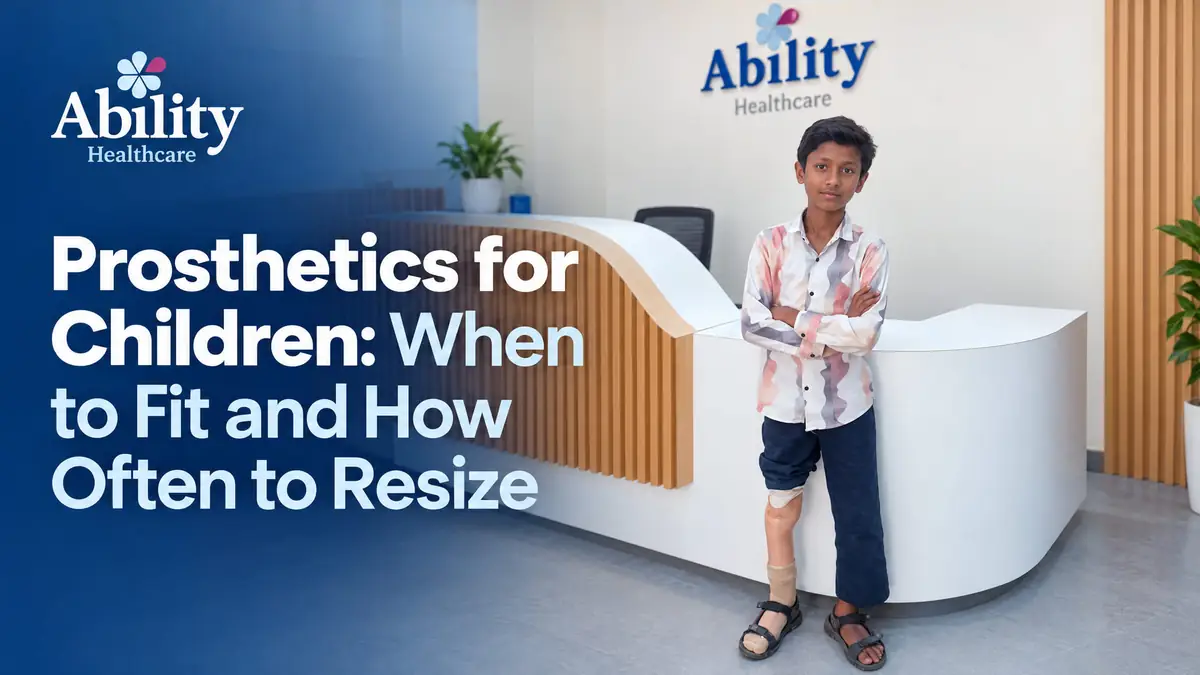
Prosthetics for children are usually first fitted around the time a child would reach for things or start to stand, and then resized often as the child grows. A review of pediatric prosthetics in the journal JPOSNA notes that children typically need a new prosthesis about every 12 to 24 months until they stop growing. The exact timing for your child depends on their development, their limb and what your care team advises.
If you are a parent reading this, you probably have many questions at once. When is the right time? Will my child accept it? How often will we need a new one, and can we afford it? This guide answers those questions in plain language.
Key Takeaways
- Leg prostheses are usually first fitted when a child begins to pull to stand.
- Arm prostheses can be fitted earlier, once a child sits steadily.
- Most children need a new prosthesis every 12 to 24 months until they stop growing, with adjustments in between.
- Under the ADIP scheme, children below 12 can receive help again after one year instead of three.
Why Do Children Need Prosthetics?
Children need prosthetics for different reasons than adults. Some are born with a limb difference. Others lose a limb through an accident or illness. A well-fitted prosthesis can help a child sit, crawl, stand, walk, hold toys, and later manage school and play with more ease.
Not every child needs one, though. The JPOSNA review on the essentials of pediatric prosthetics points out that children born with an upper limb difference often adapt very well, and that not wearing a prosthesis is a reasonable choice for many of them. The decision should always be made together with the family.
Congenital Limb Difference and Acquired Amputation
A congenital limb difference means a child is born with a limb that is missing or not fully formed. Congenital limb deficiency treatment is planned around the child’s growth and development, and it may include a prosthesis, therapy, or in some cases surgery.
An acquired amputation happens later, after injury or disease. The JPOSNA review notes that “the child born with an absent limb is different than the older child with an acquired amputation.” Older children who have lost a limb they used before often adapt well to a prosthesis, because they miss the function they had.
When Should a Child Get a Prosthetic Leg?
When should a child get a prosthetic leg? Most often, when the child starts trying to stand. The JPOSNA review states that “The ideal time to start fitting a child with a lower limb prosthesis is when they begin to pull to a stand.” The US-based Amputee Coalition, in its introduction for parents on pediatric limb loss and limb difference, says that “fitting a leg prosthesis usually happens between 8 to 14 months to help with beginning to walk.”
Child Development Milestones and Prosthetics
Rather than one fixed age for the first prosthesis, specialists look at child development milestones. Prosthetics are timed to match what the child is ready to do next, such as sitting steadily, crawling, or pulling up on furniture. A child who reaches these stages earlier or later is not “behind”. The fitting simply follows the child.
Prosthetic for Baby and Fitting Prosthetics for Toddlers
Can a baby wear a prosthetic leg? Yes, once the baby is ready to start standing. A prosthetic for a baby is simple and light. For a child with a limb difference above the knee, the first leg often has no working knee joint, so the child can learn to balance safely. Fitting prosthetics for toddlers usually means short wearing times at first, plenty of play-based practice, and frequent checks as the child grows.
When to Fit an Artificial Hand for a Child
For arms, fitting can begin earlier. The Amputee Coalition notes that “children may be fitted as early as 4 to 6 months to aid in exploring the environment,” and the JPOSNA review describes sitting balance as the traditional sign of readiness. A first artificial hand for a child is usually a passive hand, which helps with balance, crawling and holding objects with both hands.
What Happens at the First Visit
The first visit is mostly about getting to know your child. The prosthetist will look at the limb, watch how your child moves and plays, and ask about milestones and daily routines. Bring any hospital or doctor’s notes, and a favourite toy if it helps your child feel settled.
You do not need to decide anything on the day. A good first visit ends with a clear plan: whether a prosthesis is right now, what type, and when to come back. If a prosthesis is made, expect a short series of fitting visits, then regular reviews as your child grows.
Artificial Leg for Child and Artificial Hand for Child
An artificial leg for a child works like an adult’s, but it is smaller, lighter and designed to be adjusted as the child grows. The socket is often made with a little room to grow, and parts are chosen so they can be lengthened or swapped. You can read more about our artificial leg services.
An artificial hand for a child usually starts simple. As the child gets older and their needs become clearer, families may move on to body-powered or electric hands. Our guide to the bionic arm vs body-powered arm explains the differences, and our artificial hand page covers the options.
How Often Are Child Prosthetics Replaced?
How often are child prosthetics replaced? Much more often than an adult’s. The JPOSNA review says that “Children will require a new prosthesis about every 12 to 24 months until they are skeletally mature,” compared with roughly three to five years for adults. Skeletally mature simply means the bones have stopped growing.
How Often to Resize a Child Prosthesis
Between full replacements, your prosthetist will make smaller changes. How often to resize a child prosthesis depends on how fast your child is growing. In practice, that usually means regular review visits, with adjustments whenever the fit changes.
Child Prosthetic Growth Adjustments
Child prosthetic growth adjustments help a prosthesis last longer. The Amputee Coalition notes that “Prostheses will sometimes also be made slightly larger for a child to grow into the device.” Common adjustments include lengthening the pylon, adding socks or pads to the socket, changing the foot size and adjusting straps. The JPOSNA review encourages families to ask about modifications “that will extend the device’s usable life as the child grows.”
Signs a Child’s Prosthesis Needs Replacing
Watch for these signs a child’s prosthesis needs replacing or adjusting:
- Red marks that do not fade soon after taking it off
- Your child complaining of pain, or not wanting to wear it
- Walking with a limp they did not have before
- The prosthesis looking shorter than the other leg
- The socket feeling tight, or toes or skin pressing at the edges
- Visible cracks or worn parts
Outgrowing a prosthesis is normal and expected. It is a sign your child is growing, not that anything has gone wrong.
Does a Child’s Prosthesis Need Replacing Every Year?
Not always every year, but often. The 12 to 24 month guide from the JPOSNA review is a general range. Fast growth spurts may need a new prosthesis sooner, while slower periods may let one last longer with adjustments.
Adapting to a Prosthesis as a Child
Adapting to a prosthesis takes patience. Young children learn best through play, so short sessions with toys, music and games often work better than formal exercises. The Amputee Coalition reminds families that “everyone involved will need to exercise love and patience during recovery.”
A Child With a Prosthesis at School
A child with a prosthesis at school usually does well when teachers know what to expect. Tell the school about wearing times, what to do if the skin gets sore, and any activities that need a little planning. Some children like to show classmates how their prosthesis works, while others prefer privacy. Both are fine.
Sports Prosthetics for Children
Active children may later benefit from sports prosthetics for running, cricket or other games. These are usually considered once a child is walking confidently. Our sports prosthetics page explains more.
Child Prosthetic Leg Cost in India
The child prosthetic leg cost in India depends on the level of limb difference, the socket and the components. A child’s prosthesis may be smaller, but it needs replacing far more often than an adult’s, so families should plan for the total cost over several years. For a guide to price ranges, see our articles on artificial leg price in India and artificial hand price. Ability Healthcare gives a written quotation after assessment.
ADIP Scheme for Children
The ADIP scheme for children can make a real difference, because of one important rule. Under the ADIP scheme of the Department of Empowerment of Persons with Disabilities, applicants usually must not have received help for the same aid in the last three years. The official ADIP guidelines state, however, that “for children below 12 years of age, the minimum time of assistance is one year.” In practice, a growing child can get help again after one year instead of waiting three.
Free Artificial Limb for a Child
A free artificial limb for a child may be possible under ADIP if the family’s monthly income is up to ₹22,500, with 50% assistance for incomes from ₹22,501 to ₹30,000, within the scheme’s cost limits. The child needs a disability certificate showing at least 40% disability and a UDID card or UDID enrolment number, which you can apply for on the Swavlamban Card portal. Scheme rules can change, so check the official websites.
Bachon Ke Liye Nakli Pair (बच्चों के लिए कृत्रिम पैर)
Bachon ke liye nakli pair tab lagaya jaata hai jab baccha khada hone ki koshish karne lagta hai. Bacchon ka nakli haath aksar usse pehle, baithna seekhne ke samay lag sakta hai.
Bachche tezi se badhte hain, isliye unka nakli pair ya haath aksar 12 se 24 mahine mein badalna padta hai. Bachon ka nakli pair kitne ka aata hai, yeh uske design par nirbhar karta hai. ADIP yojana mein 12 saal se kam umar ke bacchon ko ek saal baad dobara sahayata mil sakti hai. Sahi jaankari ke liye kisi certified prosthetist se jaanch karwayein.
Prosthetics for Kids in Lucknow
If you are looking for prosthetics for kids in Lucknow, Ability Healthcare offers assessment, fitting and growth reviews for children at our artificial limb centre in Lucknow, as well as at our clinics in Azamgarh, Bareilly and Gorakhpur. We involve parents at every step and plan reviews around your child’s growth.
Learn more about artificial limbs for children on our main page, or visit our child prosthetics Lucknow page to book a visit.
Frequently Asked Questions
What is the right age for a first prosthesis?
There is no single right age. For legs, fitting usually starts when a child begins to pull to stand. For arms, it can begin when the child sits steadily. Your care team will advise on your child’s timing.
When can a child with congenital limb difference get a prosthesis?
A child with congenital limb difference can usually be fitted when they reach the related milestone: sitting for an arm prosthesis, or pulling to stand for a leg prosthesis.
How often will my child need a new prosthesis?
Most children need a new prosthesis about every 12 to 24 months until they stop growing, according to the JPOSNA review, with adjustments in between.
Is pediatric prosthetics different from adult prosthetics?
Yes. Pediatric prosthetics are designed to be lighter, adjustable and easy to replace, and they are planned around growth and development.
Does my child have to wear a prosthesis?
No, your child does not have to wear a prosthesis. Some children, especially those born with an upper limb difference, manage well without one. The choice should suit your child and your family.
The Bottom Line
Prosthetics for children work best when the timing follows the child’s development and when reviews keep up with growth. Expect frequent adjustments and new prostheses, plan ahead for costs and schemes, and keep your child involved in every step.
Disclaimer: This article is for general information only and is not a substitute for medical advice. Timing and replacement intervals vary for each child. Please consult a qualified doctor or prosthetist about your child’s needs.