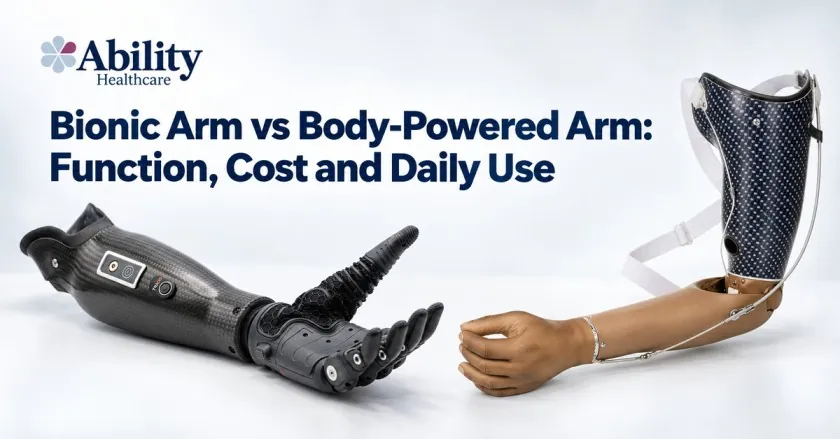
After a hand or arm amputation, most families ask the same two questions. Which artificial hand actually works, and what does it cost? The answer usually comes down to a choice between a bionic arm, controlled by muscle signals, and a body-powered prosthetic arm, controlled by your own shoulder movement through a harness.
One is not simply better than the other. They suit different jobs, different budgets and different daily routines. This guide explains the bionic arm vs body-powered arm choice in plain language: how each one works, what each costs in India, and what living with them is really like.
Quick Answer: Bionic Arm vs Body-Powered Arm
| Point of comparison | Bionic (myoelectric) arm | Body-powered arm |
|---|---|---|
| How it is controlled | Muscle signals picked up by sensors | Shoulder movement through a harness and cable |
| Appearance | Looks like a hand | Hook or hand, harness visible |
| Grip variety | Several grip patterns | One strong, simple grip |
| Weight | Heavier | Lighter |
| Durability in rough work | Needs care, avoid water and dust | Very durable |
| Feedback through the cable | Limited | Good, you feel the tension |
| Cost in India | High to very high | Low to moderate |
| Charging | Daily | None |
A 2024 review in the Journal of NeuroEngineering and Rehabilitation on the comparative benefits of body-powered and myoelectric upper limb prostheses found no consistent functional advantage for either type, concluding that “prescription practices should rely more on individual needs and preferences than cost or prosthesis design”. That is worth remembering before anyone pays for technology they may not need.
Prosthetic Arm Types: The Four Main Options
Clinically, upper limb prostheses fall into four groups. The StatPearls review published by the National Center for Biotechnology Information sets them out clearly.
- Passive or cosmetic: the most lightweight option, needing the least harnessing, chosen mainly for appearance.
- Body-powered: moderately priced and described as “the most durable on the market”, with good sensory feedback through the cable.
- Myoelectric, also called bionic: electrodes read “electrical activity from muscle contraction”, giving better function and appearance, but heavier, costlier and needing more training.
- Hybrid: a mix of cable and electric control, often used at above elbow level.
Functional vs Cosmetic Prosthetic Hand
A cosmetic hand prosthesis restores appearance and helps with balance and carrying. It does not grip. For many people who want to look and feel whole in public, it is a reasonable first choice, and our cosmetic restoration service explains it further.
A functional prosthesis, bionic or body-powered, is built to hold things. The question to ask is what you want to do on an ordinary day, not what looks most impressive in a video.
How Does a Bionic Arm Work?
What Is a Myoelectric Prosthesis?
A myoelectric prosthetic hand uses small sensors that sit against the skin of your residual limb. When you tense the muscles that used to move your wrist or fingers, those muscles still produce tiny electrical signals. An EMG sensor prosthetic hand reads those signals and a motor opens or closes the hand in response.
With practice, most people learn to send two clean signals, one to open and one to close. Switching between grip patterns is usually done with a muscle pattern, a button or an app.
Grip Patterns and the Multi Articulating Hand
A basic bionic hand offers one pinch grip. A multi articulating hand has a motor in each finger, so it can form several grips: a key grip for a door, a pinch for a pen, a wider grasp for a bottle. These are the devices most people mean when they search for a robotic hand for humans, and they sit at the top of the price range.
More grips are useful only if you will actually use them. Many users settle on two or three grips for everyday life.
How a Body-Powered Prosthetic Arm Works
A body powered prosthesis uses your own body as the engine. A harness sits across your shoulders and connects by cable to the terminal device. When you move your shoulder forward, the cable pulls and the hook or hand opens. Relax, and the springs or rubber bands close it.
Body Powered Arm Harness and Cable
The harness and cable arrangement is simple, and that is its strength. There is nothing to charge, nothing to short out in the rain, and repairs are usually quick and cheap. Because you feel the cable tension through your shoulder, you also sense how hard you are gripping, which electric hands struggle to match.
Hook vs Hand Prosthesis
The terminal device is the working end. A split hook grips precisely and is tough, and many people who work with tools prefer it. A body-powered hand looks more natural but is bulkier and has a less exact grip. Some users own both and swap depending on the task.
A Prosthetic Arm for Manual Work
For farming, workshop work, loading, or any job with dust, heat, water and knocks, a body-powered arm is often the sensible recommendation. It keeps working in conditions that would damage an electric hand, and a repair costs a fraction of a motor replacement. That matters across Uttar Pradesh, where many patients work with their hands for a living.
Myoelectric vs Body Powered Prosthesis: Feature Comparison
| Feature | Bionic hand | Body-powered arm |
|---|---|---|
| Control | Muscle signals | Shoulder movement and cable |
| Harness | Often not needed | Required |
| Effort to operate | Low physical effort | Needs shoulder movement all day |
| Grip strength | Motor dependent | Strong and direct |
| Water and dust | Avoid | Tolerant |
| Repairs | Specialist, costlier | Simple, usually local |
| Training required | More | Less, but still needed |
| Appearance | Natural looking | Functional looking |
Below Elbow vs Above Elbow Prosthesis
Where the amputation sits changes everything about what a prosthesis can do.
A below elbow prosthesis, clinically a transradial prosthesis, replaces the hand and part of the forearm. Your own elbow still works, which makes control easier and learning faster. StatPearls notes that a transradial fitting generally needs at least 5 cm of residual limb to work with.
An above elbow prosthesis has to replace the elbow as well, so the arm is heavier and control is more demanding. StatPearls notes that hybrid prostheses, combining cable and electric control, are generally used at this level, typically with a cable elbow and an electric hand. Higher still, at shoulder level, it observes that the extra weight and energy demands lead many patients to choose a purely cosmetic prosthesis.
A partial hand prosthesis is used when some of the hand remains. These fittings are highly individual and often combine silicone restoration with small functional fingers.
Artificial Hand Cost in India: What to Expect
There is no single artificial hand price, because a hand is built around your limb and your work. The bands below are indicative for the Indian market and cover the device, not the full rehabilitation programme.
| Type of prosthesis | Indicative price band in India |
|---|---|
| Passive or cosmetic hand | Around ₹15,000 to ₹80,000, more for custom silicone |
| Body-powered below elbow arm | Around ₹25,000 to ₹1,00,000 |
| Body-powered above elbow arm | Around ₹40,000 to ₹1,50,000 |
| Single-grip myoelectric hand | Around ₹1,50,000 to ₹5,00,000 |
| Multi-articulating bionic hand | ₹6,00,000 and upwards |
Indicative only. Prices change with brand, socket design, components and exchange rates. Ability Healthcare gives a written quotation after assessment.
Bionic Arm Price in India
The bionic arm price in India is driven by the hand itself, the number of grips, the socket, and the electrodes. The myoelectric hand price in India for a basic single-grip device is far lower than for a multi-articulating one, so the bionic hand price in India depends mostly on how many grips you will actually use. When people ask how much does a bionic arm cost, the honest answer is that a bionic arm in India can range from a few lakh to well over twenty lakh.
Body Powered Prosthesis Cost
Body powered prosthesis cost is one reason this option is still widely fitted across India. A well-made body-powered arm costs a fraction of a bionic one, and its servicing is cheaper too.
Artificial Hand for Handicapped Price
Families searching for the artificial hand for handicapped price, or for an artificial hand for handicapped in India, are often comparing prices that are not comparable: a cosmetic hand against a bionic one. Always ask what is included. The prosthetic hand price in India should cover socket fabrication, fitting sessions, training and follow-up, not just the device in a box.
Free Artificial Hand Scheme and Government Support
Under the ADIP scheme run by the Department of Empowerment of Persons with Disabilities, Indian citizens with at least 40% disability and a monthly income within the scheme limits can receive aids and appliances, including upper limb prostheses. The official guidelines provide full assistance for incomes up to ₹22,500 a month and 50% for ₹22,501 to ₹30,000, within set cost ceilings, and list a separate subsidy for a high end prosthesis. A disability certificate or UDID card is needed, available through the Swavlamban Card portal.
The ADIP scheme artificial hand route is most likely to cover a basic or body-powered device rather than a bionic one. Scheme rules change, so check the official sites before applying.
Daily Use, Training and Care
How to Use a Prosthetic Hand
The first weeks are about small, repeated tasks: picking up a cup, holding a plate steady, opening a door. Most people start by using the prosthesis to stabilise while the sound hand does the fine work, then build from there.
Prosthetic Hand Training
Prosthetic hand training is not optional, particularly with a myoelectric device. Sessions teach you to fire the right muscle cleanly, switch grips without thinking, and use the arm in real situations. A prosthetic hand for writing and eating usually holds the paper or the bowl while your other hand does the detailed work, which is a normal and efficient way to use it.
Bionic Hand Battery Life and Prosthetic Arm Maintenance
A bionic hand is charged daily, much like a phone, and most last a full day of normal use. Prosthetic arm maintenance means keeping the socket and liner clean, checking the harness or electrodes for wear, protecting electric hands from water and dust, and attending review appointments. Body-powered arms mainly need cable, rubber band and harness checks.
How Long Does a Prosthetic Hand Last?
With reasonable care, a prosthetic hand often lasts around three to five years before major parts need replacing. The socket usually needs changing sooner, especially in the first year as the residual limb settles, and children need replacements far more often as they grow. Our child prosthetics service covers that separately.
कृत्रिम हाथ की कीमत: Hindi Mein Jaankari
Log aksar poochhte hain ki nakli haath ki kimat kitni hoti hai, ya कृत्रिम हाथ की कीमत kis cheez par nirbhar karti hai.
- Nakli haath: Sirf dikhne ke liye banaya gaya cosmetic haath sabse kam kharch mein aata hai, lekin isse pakadne ka kaam nahi hota.
- बायोनिक हाथ: Ismein muscle signals se ungliyan chalti hain, isliye keemat lakhon mein hoti hai aur training bhi zaroori hoti hai.
- Plastic hand for handicapped: Kai log isi naam se poochhte hain. Yeh aam taur par cosmetic ya body-powered haath hota hai, jo mazbooti aur kam kharch ke liye jaana jaata hai.
Sahi vikalp chunne ke liye apne kaam, budget aur roz ke istemal ko dhyan mein rakhein, aur kisi certified prosthetist se jaanch karwayein.
Artificial Hand in Lucknow: Assessment and Fitting
At our artificial limb centre in Lucknow, the process begins with an assessment rather than a product. We look at the length and condition of your residual limb, the muscle signals available, your work, and what you want to do again. Trials matter: holding something with a hook and with an electric hand tells you more than any brochure.
If you are searching for an artificial hand in Lucknow, a prosthetic hand in Lucknow, or a bionic hand in Lucknow, ask any clinic who fits the device, who services it, and what training is included. As an artificial hand centre in Uttar Pradesh, we also see patients at our Azamgarh, Bareilly and Gorakhpur clinics.
Our upper limb services include:
- Assessment and muscle signal testing before any device is recommended
- Cosmetic, body-powered and myoelectric options explained side by side
- Custom socket design with 3D scanning
- Training and follow-up reviews
- A written quotation covering the full fitting, not just the device
You can read more about our artificial hand services and our robotic and multi-articulating hand options.
Which Is Better, Bionic or Body Powered Arm?
- Choose a body-powered arm for manual work, rough conditions, low running costs and dependable grip.
- Choose a bionic hand if appearance and varied grips matter, your work is lighter or office based, and the budget and service support are there.
- Choose a cosmetic hand if appearance and comfort are the priority and you do not need grip.
- Consider a hybrid at above elbow level, where a cable elbow with an electric hand often works best.
Frequently Asked Questions
Can a bionic hand feel?
Not in the way a real hand does. Most bionic hands give no touch sensation, although some newer systems offer limited feedback. Body-powered arms give an indirect sense of grip through cable tension.
Is a bionic arm worth it?
It depends on your daily tasks. Published evidence has not shown a consistent functional advantage for either type, so the decision should follow your needs rather than the price tag.
Which is better for farm or workshop work?
A body-powered arm, in most cases. It tolerates dust, water and knocks far better and is cheaper to repair.
How soon after amputation can an arm prosthesis be fitted?
Once the wound has healed and swelling has settled. Your surgeon and prosthetist decide together, and early training helps.
Does any scheme cover an artificial hand?
The ADIP scheme can support eligible applicants within its cost limits. Check the official DEPwD website for current rules.
The Bottom Line
The bionic arm vs body powered arm decision is about your life, not about which device is more advanced. Match the prosthesis to your work, your budget and your ability to maintain it, get the socket right, and commit to the training. That combination decides how much you actually use the arm, which is the only measure that counts.
Disclaimer: This article is for general information only and is not a substitute for medical advice. Prices are indicative and may vary. Please consult a qualified prosthetist about your own situation.